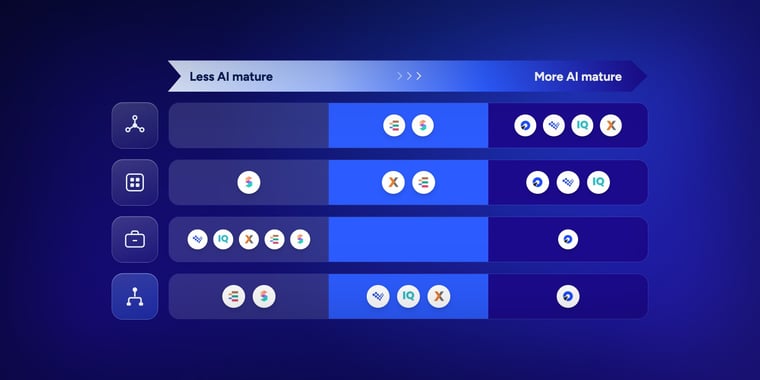
When it comes to ICM software, AI’s value hinges on its accuracy. If it makes faulty assumptions, you can’t trust it to analyze your sales data, optimize your comp plan, and automate workflows. That’s why it’s important to consider an ICM AI’s contextual maturity, or how much it understands about the context in which it’s working, when evaluating sales commission solutions.
To be consistently reliable and accurate for ICM, AI needs to understand:
- Your ICM software
- Your sales data
- Your business
- The interactions between these areas
In this article, we’ll break down these areas and explore how today’s best ICMs stack up.
The 4 crucial areas of AI contextual awareness in ICM solutions
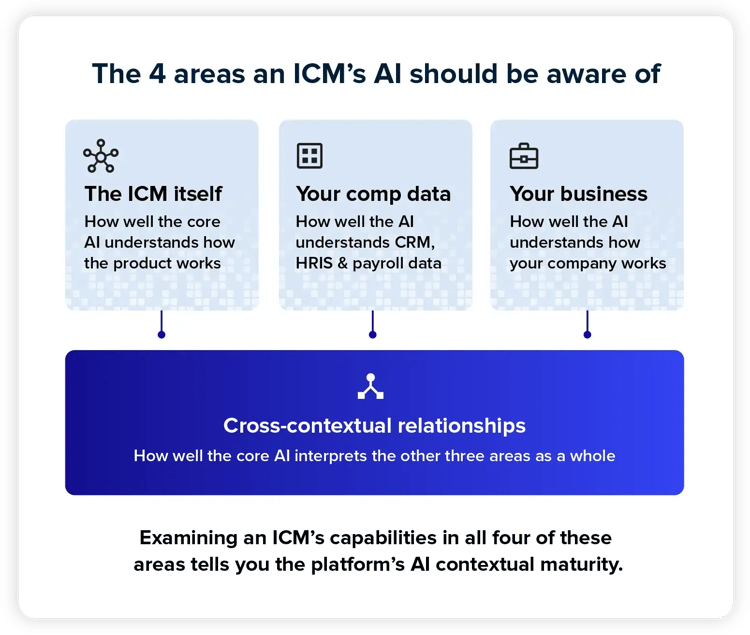
Ideally, an ICM’s AI should be able to respond to prompts and carry out tasks with a precise understanding of how the ICM software works, how to use your sales data, what your business needs, and how each of those areas interact in a specific application: whether it's a report, a payout dispute, a forecast, optimization recommendations, or something else entirely.
When one of these layers of context is missing, ICM AIs have to make assumptions. They may not know how your CRM data is structured, or how regulatory restrictions or budget caps should impact outcomes, reports, or projections. It’s a gap that gets filled by a “best guess” instead of concrete information about your specific business, tools, and data.
Every ICM is working to improve their AI maturity in all four areas, but they’re all at different stages of the process and taking different routes to get there. Some have developed AI with a strong understanding of a particular area, like how to build plans and calculate payouts within their ICM, but limited ability to draw from other contexts, like your targets, goals, and constraints.
So far, only one ICM software has managed to develop AI maturity in all four areas.
1. Understanding the ICM software and compensation plans
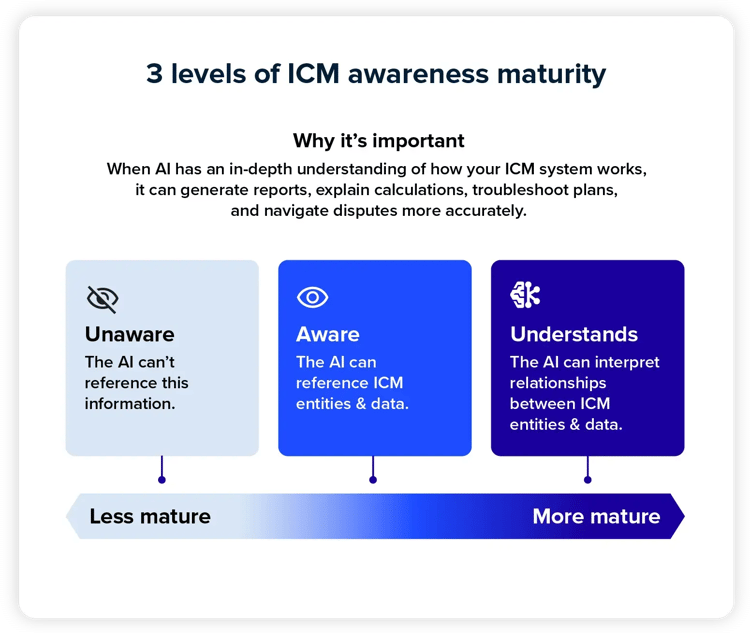
Leading ICM AIs typically have a fairly high degree of ICM awareness. Vendors have equipped their AI with enough information about their own software that it can be trusted to analyze and report on ICM data, recommend plan optimizations, and explain calculations because it understands how the system behaves and what’s supposed to happen in specific situations.
AI that understands its ICM context knows how compensation plan mechanisms work, how they’re set up in the software, and how that leads to a particular outcome.
Why ICM awareness matters: Every time you ask an ICM’s AI to generate reports, explain calculations, troubleshoot plans, or help with payout disputes, it will lean on its ICM awareness.
2. Understanding CRM, HRIS, and compensation data
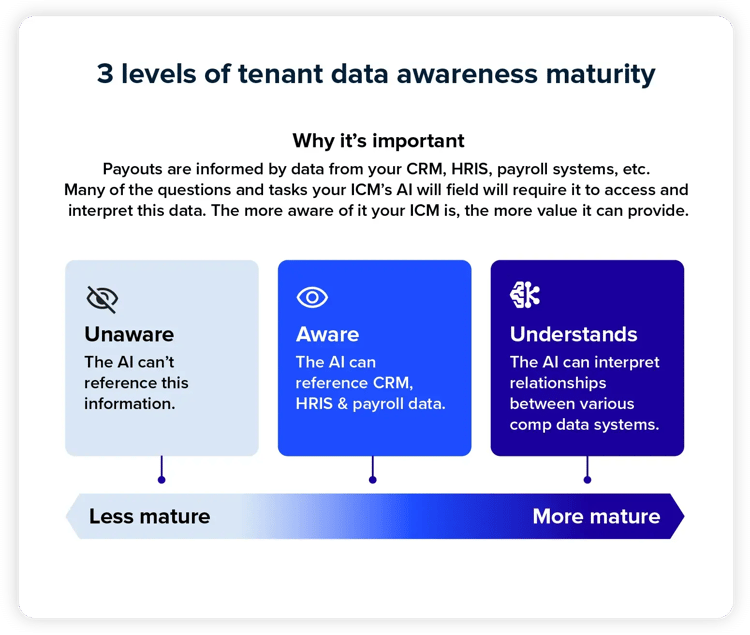
Tenant data awareness refers to how well an ICM’s AI understands the information that comes from other sources, like your CRM, HRIS, and payroll system. Most of the top ICM software solutions can at least access this data, but the best ones can reliably interpret it.
Less mature AIs may occasionally get by with a general understanding of how external systems typically work and what deals look like. But at times, the unique architecture of these other tools and how your data is configured within them will directly affect the best solution, recommendation, or output. You don’t want AI making assumptions about your CRM data.
Why tenant data awareness matters: Payouts and other compensation calculations depend on data from other systems. Your ICM AI’s ability to access and correctly interpret this data to answer questions and perform basic tasks depends on its tenant data awareness.
3. Understanding your business context
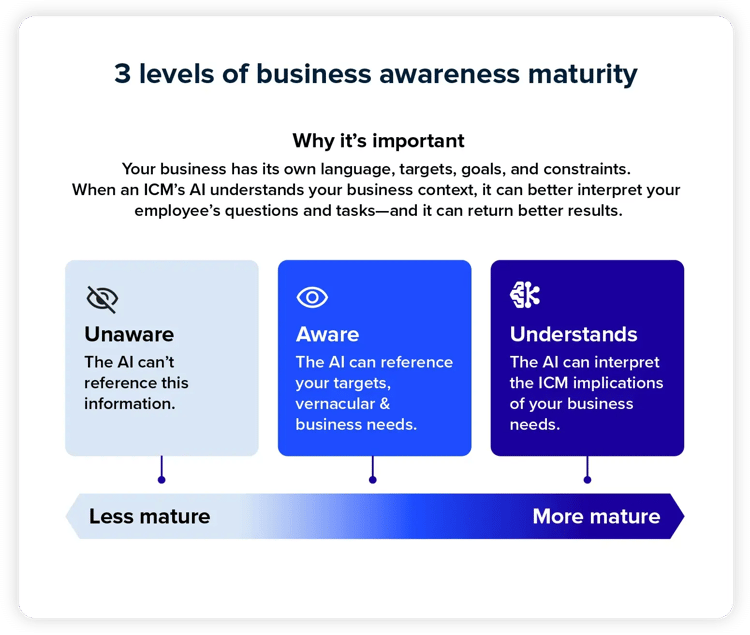
Unfortunately, most ICM software is still maturing when it comes to understanding business context. This type of contextual awareness is about how well the AI knows your unique business operations, goals, targets, constraints, and vernacular.
Without this context, the AI is left to make assumptions about your business needs. Put another way: its recommendations and automated actions won’t be informed by what you’re trying to accomplish. Employees will have to provide that context every time they use the AI, or else intuit how the AI’s generalized outputs relate to your specific business needs.
Why business awareness matters: You don’t want generally applicable recommendations. Your business’ language, targets, goals, and constraints should all impact the outputs employees receive from your ICM’s AI. But that only happens when the AI actually understands your business context.
4. Connecting ICM, sales data, and business context
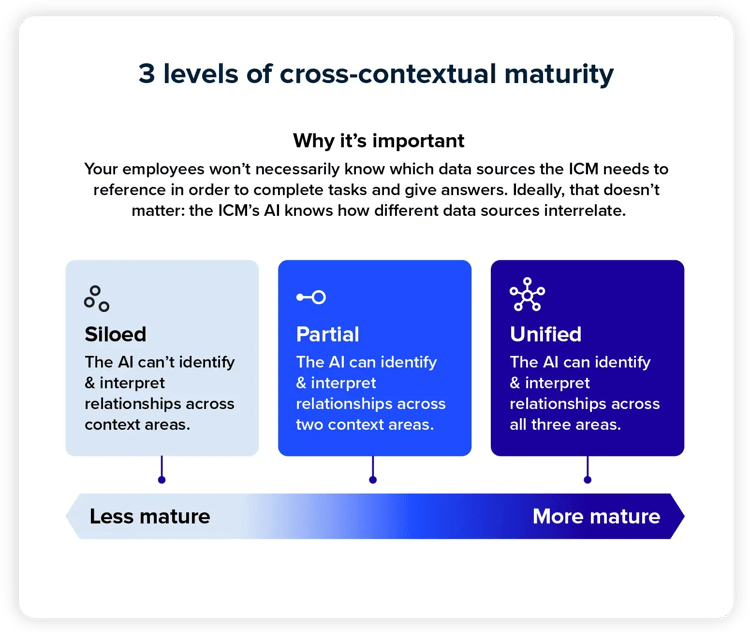
Cross-contextual maturity refers to how well an ICM software’s AI understands the way your ICM software, sales data, and business context interact. A high degree of cross-contextual maturity means your AI reliably knows what inputs it needs from which systems to provide the right output, and how a change in one area will impact another.
For example, when an employee asks what sales activities they should focus on to maximize their earning potential, a high level of cross-contextual maturity ensures that the AI will provide the best recommendations based on their sales role, how your goals and targets relate to your specific plan composition, and the way work is attributed in your CRM.
Most of today’s ICM AIs are still growing in cross-contextual awareness.
Why cross-contextual matters: When sales reps and admins use your ICM’s AI, they shouldn’t need to explain what data sources the AI needs to reference. An AI’s cross-contextual maturity governs how well it understands (and correctly applies) the relationships between different data sources.
How leading ICM software solutions compare on AI contextual maturity
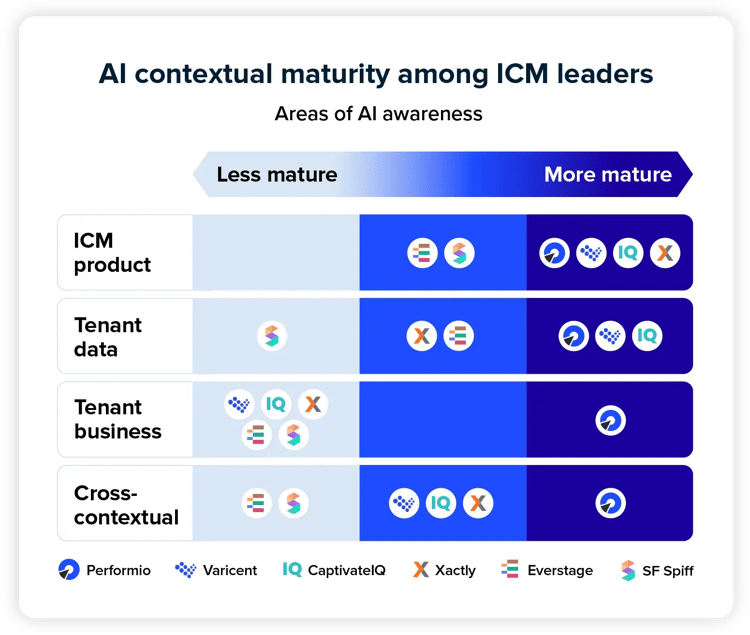
When it comes to AI contextual maturity, ICM vendors are playing catch up with Performio. No other AI can interpret how your business needs impact specific ICM processes. And that contextual gap makes it impossible for other AIs to understand how each of these contexts interacts. (It’s one of the reasons Performio’s AI agents were able to reduce implementation times by 87%.)
While other ICMs have split their attention chasing the broader SPM market, Performio has remained committed to solving the challenges of ICM. And this is one of the areas where that difference in priorities shows most strongly.
Performio’s AI contextual maturity makes it highly versatile. Its recommendations, explanations, and other outputs are never generalized or built on assumptions about your business, your data, or the software itself. They’re grounded in your unique context.
While other vendors have been focusing on automating ICM tasks with agentic AI, we’ve known all along that the value these agentic use cases can provide would depend on their foundation. And with the most contextually aware AI in ICM, we’re already seeing this emphasis pay off in the quality of its AI dispute management and plan generation capabilities.
Want to see what sets Performio’s AI apart? Request a demo today.
Compare the best ICM software across 12 key factors
AI contextual maturity is just one of many factors you should consider as you evaluate ICM software. In fact, it’s one of twelve core factors we graded six leading ICM providers on.
Through our Incentive Compensation Trends Report, third-party publications like the 2025 Forrester Wave, and our implementation consultants’ expertise, we identified 44 capability areas that affect your experience with ICM software and grouped them into these 12 factors. For each factor, we scored leading ICM solutions based on their actual capabilities, not our own preferences.
Whether you’re looking into ICM software for the first time or ready to make a switch, our detailed guide makes a great starting point.
Read the full buyer’s guide here.
Related Topics

Related Posts