AI can cut ICM implementation from months to weeks, but only when it's grounded in the right architecture.
Every ICM vendor is saying the same thing right now: AI will collapse implementation from months to days. They're mostly right about the outcome, and mostly wrong about the reason.
AI doesn't compress ICM implementations because it's clever. It compresses them when the platform underneath it was built in a way that lets AI work without guessing. Get that foundation right and the timeline falls away. Get it wrong and you've added a confident, fluent, wrong collaborator to an already complex process.
In Part 1 of this series, we looked at why traditional ICM implementations have taken so long. This piece goes one layer deeper: what AI actually needs to reduce time to value, and why most platforms can't give it that.
The real constraint isn't AI. It's context.
Generative AI is a probabilistic engine. It reads what it's been given and predicts, token by token, what should come next. When the context is clear, its predictions are reliable. When the context is ambiguous, it picks whichever continuation looks most plausible on average, which is a polite way of saying it guesses.
It's the difference between asking AI to finish "the capital of France is ___" and asking it to finish "the commission rate for Enterprise deals in Q4 is ___". One has a single obvious answer. The other has a hundred plausible ones, and the model will happily commit to whichever sounds most confident, even if the real answer lives in a table it was never shown.
In most software categories, a wrong AI output is an inconvenience. In ICM, it's a mispaid rep, a broken trust chain with the sales team, an audit finding, a payroll cycle you have to unwind. And the rework lands on a sales ops admin who is already holding three quarters of the business together with spreadsheets and willpower.
So the interesting question isn't "does this platform have AI?" or "is it AI-native?" Every platform is saying both of those things. The real question is "can the AI actually see what it needs to see, or is it guessing?"
Formula-driven platforms give AI a wall of cell references with no semantics. Rules engines give it a clearer picture but force customers to bend their comp plans to fit rigid if/then logic, which defeats the point of using ICM software in the first place. Only component-based platforms expose typed inputs, typed outputs, and explicit dependencies: the kind of structure AI can actually reason over without making things up.
What AI needs to work reliably in ICM
Three things have to be true before AI can meaningfully accelerate an implementation.
1. A consistent data model
Every compensation plan is different. (If they were all the same, there wouldn't be so many ICM vendors fighting over the same deals.) The trap is that flexibility usually comes at the cost of structure, and AI needs both.
Performio's answer is a Standard Data Model (SDM), which we call our Adaptable ICM Core. We looked at how incentive plans operate across thousands of implementations and found the same progression underneath almost all of them: data comes in, eligibility is determined, plan logic is applied, incentives are calculated and reported. We turned that progression into a standard skeleton that sits under every Performio tenant, with a semantic layer so objects carry consistent meaning across the system. Customers still model their own bespoke plans on top of it; the skeleton just guarantees the bones stay in the same place.
That structure is what makes AI viable. In a loosely structured ICM, an AI system has to infer how tables relate before it can help. In the Adaptable ICM Core, there's nothing to infer. The AI knows where source data lives, what a credit looks like, what "incentives earned" actually means.
Just as importantly, the data model gives AI a clear lane. The deterministic steps stay deterministic: eligibility, crediting, calculation, payout. Those never move into the model. AI handles what AI is good at, like reading messy inputs, drafting structure, explaining behavior, and spotting anomalies. It stops at the boundary where math begins. Guardrails aren't bolted on. They're a function of the architecture.
2. Modular, component-based logic
Many ICM platforms are essentially spreadsheets underneath, with logic living in formulas. It's flexible but brittle, and nearly impossible for AI to read without hallucinating intent. Rules engines are harder to break but harder to customize, and they end up forcing sales teams to reshape comp plans to fit platform limits. That's the tail wagging the dog.
Performio takes a third path: behavior is modeled as reusable components. A component does one specific thing, like transforming data, assigning credit, or applying a calculation, and connects through explicit inputs and outputs. Admins assemble and adjust plans by configuring components, not by rewriting logic.
The same properties that make component-based ICM good for humans make it ideal for AI. Components expose their I/O. Dependencies are explicit. The AI doesn't need to read formulas and guess at relationships; it reads the configuration directly and understands how a change in one place ripples elsewhere.
This architecture also gives AI something most platforms can't: a foundation for memory. Every component, every configuration choice, every plan change becomes context the AI can draw on next time. By the time you're a year in, Performio's AI doesn't just know how ICM works in general. It knows how your business operates: which products carry accelerators, how crediting splits get resolved, how your team handles mid-year plan changes. So when your VP of Sales Ops comes back in Q3 saying "we need to redo the SPIFF logic for the new segment," the AI isn't starting from a blank page. It's starting from your own history, and the change lands faster because of it.
3. Grounded access to the tenant
This one's simple. AI should not be reasoning from training data when the answer is sitting in the system. Performio's agents connect directly to the customer's tenant: APIs, database, configuration, calculation outputs. They inspect the actual environment rather than predicting what the answer should probably look like.
The architecture in one picture
Pull these three ideas together and you get two layers doing very different jobs.
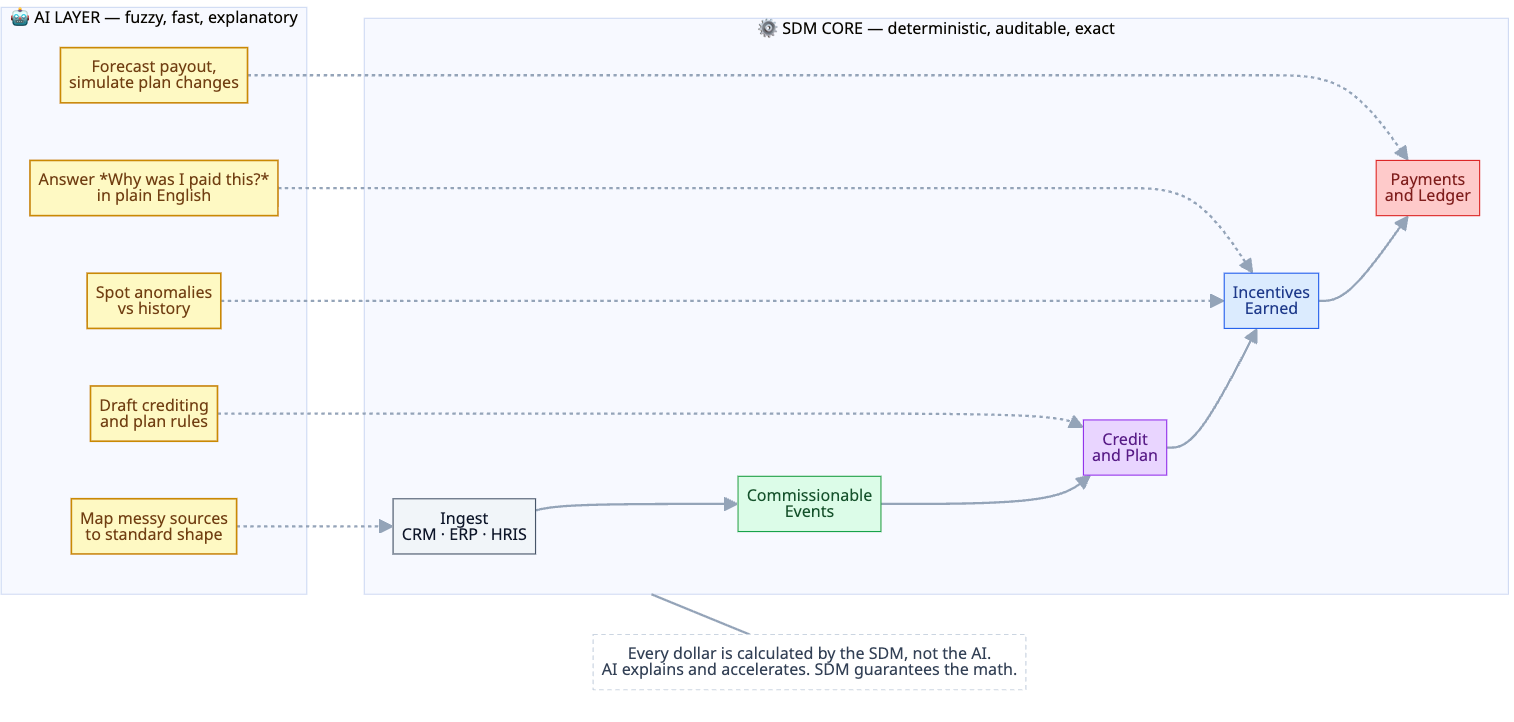
On one side is the deterministic core. Ingest brings CRM, ERP, and HRIS data into a common shape. Commissionable events feed credit and plan logic, which produce incentives earned, which flow into payments and the ledger. Every dollar the customer pays is calculated by that pipeline. It's auditable, testable, and it doesn't change behavior based on how you phrase a prompt.
On the other side is the AI layer. It maps messy source data to the standard shape, drafts crediting logic and plan rules, spots anomalies against history, answers "why was I paid this?" in plain English, and forecasts payouts before you ship plan changes.
Every dollar is calculated by the Adaptable ICM Core, not the AI. AI explains and accelerates. The Adaptable ICM Core guarantees the math.
The internal agents that actually do the work
The acceleration in an implementation comes from a set of internal agents that Performio's delivery teams use every day. These aren't customer-facing features bolted onto the product. They're purpose-built tools that sit alongside our implementation consultants, operating on the Adaptable ICM Core and component library. The customer sees the result: faster go-live, fewer surprises, a cleaner handover.
The Documentation Agent. Implementation traditionally starts with a documentation marathon: workshop notes, demo artifacts, meeting transcripts, and design sketches turned into a structured business requirements document. It's where most implementations quietly lose their first week. The Documentation Agent produces the structured draft directly from those inputs, flagging inconsistencies and logical gaps that humans miss when stitching together fifteen sources by hand. Work that used to take around fifteen hours of manual effort now takes about an hour of AI-assisted drafting and curation.
The Configuration Agent. Once requirements are clear, the Configuration Agent translates intent into working configuration. It's connected directly to the platform's APIs and database, backed by an internal knowledge base of how Performio solutions are typically built. It creates structured objects like data tables, importers, and components, and traces how components connect when someone needs to understand why a configuration behaves a certain way. The human stays in control of intent and approval; the agent handles the repetitive, click-driven build work.
The Testing Agent. UAT is the hardest part of any implementation and the biggest single lever on time to value. The Testing Agent generates structured test scenarios (positive, negative, and edge cases) from documented requirements and actual platform configuration. On the validation side, it compares calculation outputs to expected results and produces reports. Teams stop spending days writing scenarios and running spreadsheet comparisons, and start the UAT cycle with an AI-generated analysis already in hand.
Post go-live self-service. Implementation should happen once and serve as the foundation for everything that follows. Performio's Admin Assistant brings AI directly into the product so customers can extend and refine their programs on top of that foundation, without routing every change through professional services.
The divide is architectural
AI can dramatically shorten ICM implementations. It's doing so right now. But the acceleration is not evenly distributed, and it won't be. The platforms that are built on a standard data model and component-based logic will compound their advantage, because their AI has something real to work with. The platforms that layered AI on top of formula soup will keep running into the same hallucination problem, because the underlying structure never existed to begin with.
The question to ask any vendor isn't whether they have AI. It's whether their architecture earned the right to use it.
To see what this looks like on your own data, request a demo.
Related Topics