CallidusCloud Commissions was a well-established name in incentive compensation management (ICM) software. Built to support enterprise sales organizations, it earned a reputation for handling complex compensation plans at scale.
But CallidusCloud Commissions no longer exists as a standalone product. In 2018, SAP acquired Callidus Software Inc. and integrated its commission platform into SAP’s broader Sales Performance Management portfolio. Over time, the original product was rebranded as SAP Commissions and folded into the SAP SuccessFactors ecosystem alongside other enterprise sales and HR tools.
SAP has continued evolving the platform’s architecture, migrating toward its SAP HANA infrastructure and consolidating functionality within its larger enterprise stack. For long-time users, this shift has meant navigating replatforming decisions, architectural transitions, and a product experience that differs from the original CallidusCloud era. Many organizations that once relied on CallidusCloud must now decide whether to remain within SAP’s ecosystem or evaluate modern ICM alternatives.
If you’re exploring alternatives to CallidusCloud Commissions, here’s your shortlist:
- Performio: Enterprise performance without compromise
- Varicent: Advanced testing abilities, but technically demanding
- CaptivateIQ: Strong data management, but limited support for complexity
- Xactly: Agile plan management that struggles to scale
- Everstage: Fast onboarding, but limited overall
In this article, we’ll evaluate these five ICM solutions using our comprehensive scoring rubric, highlighting where each platform excels and struggles, so you can determine which CallidusCloud Commissions alternative is the best fit for your organization.
What users appreciated about CallidusCloud Commissions
When CallidusCloud Commissions operated as a standalone product, it built a loyal user base by delivering reliable commission calculations at scale and supporting complex compensation plans in a centralized system. For its time, it was considered capable, reasonably intuitive, and effective for real-time commission tracking.
Its challenges were largely tied to user experience, as the ability to handle complex compensation plans often came at the expense of usability. The implementation process could be lengthy, administration required technical expertise, and making plan changes involved more effort than many teams expected.
But expectations for ICM software have evolved. Today, organizations don’t just want accuracy and complexity support, but faster onboarding, intuitive workflows, and the ability to make changes on the fly without needing to involve IT or professional services.
Rather than simply finding a one-to-one replacement for CallidusCloud Commissions, this is an opportunity to look for an upgrade, building on what worked while removing the friction that came with it.
How we evaluated CallidusCloud Commissions competitors
We evaluated the leading ICM platforms on the market in late 2025, objectively comparing their real-world capabilities. This evaluation process drew from multiple sources: findings from our 2025 Incentive Compensation Trends report, respected industry reports like the 2025 Forrester Wave, and the first-hand experience of our implementation consultants. From that research, we identified 10 core factors that most directly impact day-to-day incentive compensation management:
- Technical skill required
- Safe testing & experimentation capabilities
- Custom reporting capabilities
- Out-of-box complexity support
- Common-sense workflows
- Data management & transformation capabilities
- Scalability
- Agility
- Onboarding momentum
- Customer support quality
We developed a 1–5 scale to rate each factor, with clearly defined criteria for every score. We then graded each vendor against those criteria, applying weightings based on survey data from ICM professionals to calculate overall rankings. The goal was to create direct comparisons that reflect what actually matters in day-to-day sales comp administration.
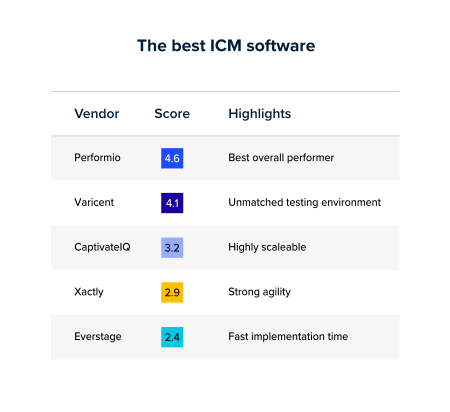
Because CallidusCloud Commissions no longer exists as a standalone product, we weren’t able to include it in that evaluation. But since we have objective scores for the major CallidusCloud Commissions competitors, we can compare them on equal footing.
For a detailed breakdown of the methodology and scoring criteria, see our ICM Buyer’s Guide.
Top CallidusCloud Commissions alternatives
The top CallidusCloud Commissions alternative is Performio, combining support for complex compensation structures with ease of administration, the ability to make quick changes, and best-in-class customer service. Other leading CallidusCloud Commissions competitors include Varicent, Xactly, CaptivateIQ, and Everstage. Each offers distinct strengths—along with significant tradeoffs.
Performio: Enterprise performance without compromise
If you valued CallidusCloud Commissions’ ability to handle complex compensation plans at scale, Performio delivers the same level of sophistication, but without requiring extensive technical expertise to maintain it. Performio balances enterprise-grade capability with true day-to-day usability.
|
Pros |
Cons |
|
|
Easy to manage without technical skills
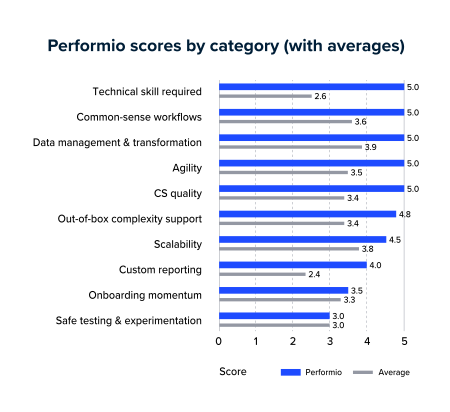
Across our 10-factor rubric, Performio is the only ICM platform that meets or exceeds the average in every category. It performs especially well in areas that directly impact ongoing administration, earning top marks in technical skill required, workflows, data management & transformation, agility, and customer support quality.
Unlike competitors that require coding knowledge, spreadsheet formulas, or advanced workflow logic, Performio is designed to be largely self-sufficient for admins. Most plan modifications, rule updates, and report generation can be handled directly within the platform, without heavy reliance on IT or vendor intervention. That accessibility is paired with strong built-in ETL capabilities and batch processing, ensuring data management is straightforward and accurate.
Architecture built to support complexity
Performio also offers broad out-of-the-box support for sophisticated plan components—SPIFs, custom hierarchies, multiple crediting models, rate adjustments, and mid-cycle changes. Its component-based logic allows organizations to modify plans without reconfiguring the platform itself, preserving flexibility as compensation strategies evolve.
That same component-based architecture also uniquely positions Performio to leverage emerging AI capabilities. Because Performio’s compensation logic is structured and modular, AI can integrate directly and access the context it needs to ensure accurate and reliable outputs.
Flexible plan updates with controlled testing
Performio supports both future-effective planning and mid-cycle updates. Admins can make adjustments without disrupting ongoing calculations, so fast-moving sales organizations don’t have to slow their pace to accommodate system limitations.
Testing and experimentation are solid, though not the most expansive in the market. Performio provides multiple testing environments and version control across runtime and test instances, enabling safe iteration without affecting live operations. While some competitors offer slightly more extensive sandbox capabilities, Performio’s testing support is sufficient for most use cases.
Reliable onboarding and standout support
Onboarding momentum is steady and predictable. G2 reports average implementation times of around four months, and Performio includes complementary break-fix consulting and bespoke training by default. Time to value averages about eight months.
In customer support, Performio defines time-sensitivity requirements, guarantees resolution times for premium support customers, and was the only ICM vendor recognized with a halo in the 2025 Forrester Wave for above-average customer feedback.
Performio leads the field with consistently strong performance across every major evaluation factor, combining enterprise-grade complexity with true day-to-day usability. For organizations that want powerful capabilities without unnecessary technical overhead, Performio is the strongest CallidusCloud Commissions alternative available.
Varicent: Advanced testing abilities, but technically demanding
If your priority is rigorous plan validation and consistent performance at scale, Varicent is a strong contender. It delivers extensive testing control and reliable data processing. But it requires significant technical expertise to administer effectively.
|
Pros |
Cons |
|
|
Advanced testing with full-platform control
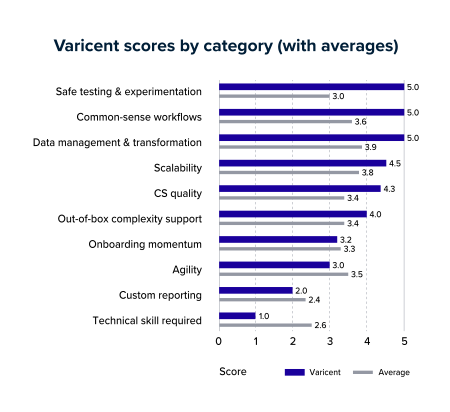
Varicent’s strongest differentiator is testing and experimentation. It’s the only vendor evaluated that offers a full-platform sandbox. Combined with version control across runtime and testing environments, this makes it particularly well suited for organizations that prioritize validating plan changes before deploying them live.
It also performs well in workflows, data management and transformation, and scalability. Varicent supports multi-level approvals, conditional workflows, and dispute resolution processes, while enabling admins to manage territories, add data points, and maintain Salesforce integrations directly within the platform.
Technically demanding to administer
Varicent’s weakest point is the amount of technical skill required to use it, requiring expert-level proficiency in programming, workflow logic, reporting, and data management. Even routine tasks like building reports or adjusting plan logic require advanced knowledge. And while custom reporting is supported, it isn’t intuitive for non-technical users.
Slow updates and longer timelines
Varicent supports future-effective planning and mid-cycle adjustments, but executing those changes often involves substantial system configuration. Onboarding momentum is also slower than most competitors. According to G2 data, implementation averages around 8 months, with time to value extending considerably longer at around 23 months.
Customer support is above average, with consistently fast SLA response times, though Varicent doesn’t define time-sensitivity requirements or guarantee resolution times at premium tiers.
Varicent is best suited for organizations that prioritize advanced testing capabilities and dependable performance, but only if they have the technical resources to support it. It offers depth and control, but with more complexity and longer timelines than many other CallidusCloud Commissions alternatives.
Compare Varicent and Performio head to head >>
CaptivateIQ: Strong data management, but limited support for complexity
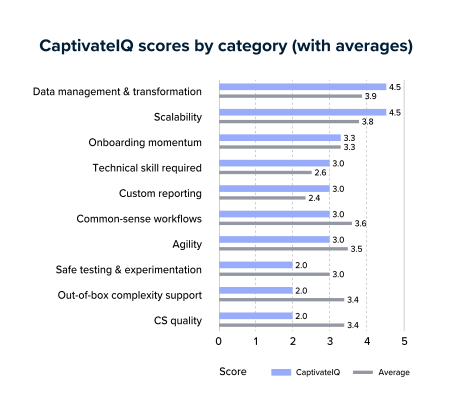
For streamlined data handling and good scalability, CaptivateIQ is a practical option. But it provides limited support for complex plan mechanisms or testing environments, and customer support is lacking.
|
Pros |
Cons |
|
|
Strong data management and scalability
CaptivateIQ’s strengths lie in data management and scalability. It includes built-in ETL capabilities, allowing teams to transform data in-tool without heavy IT involvement. And admins can manage territory reorganizations, add new data points, and partially automate payee onboarding directly within the platform.
Mixed onboarding and technical demands
Onboarding momentum is more mixed. According to G2 data, implementation averages around 3 months, which is faster than most competitors. But time to value averages closer to 15 months, which is on the longer side.
CaptivateIQ is easier to navigate than some of the more technically demanding platforms, but it still requires proficiency in SQL, data modeling, and spreadsheet formulas to access its full capabilities.
Limited testing, complexity, and customer support
Where CaptivateIQ shows more limitations is in the areas of testing and complexity. It offers no fully productized sandbox environment and no version control. And out-of-the-box support for complexity is limited primarily to rate management, with little native support for SPIFs, custom hierarchies, multiple crediting models, or participation changes.
Workflows are restricted to payout approvals and don’t include support for disputes or conditional logic. While “build now, activate later” functionality exists for future plans and mid-cycle changes, many adjustments still require platform reconfiguration.
Customer support is also one of CaptivateIQ’s weaker areas. SLA response times are slower than most competitors across severity levels, and the platform doesn’t define time-sensitivity standards or guarantee resolution times at premium tiers.
CaptivateIQ handles data well and scales effectively, but its limited testing capabilities and narrower support for complex plan mechanisms make it less suited for organizations with advanced or rapidly evolving compensation structures.
Compare CaptivateIQ and Performio head to head >>
Xactly: Agile plan management that struggles to scale
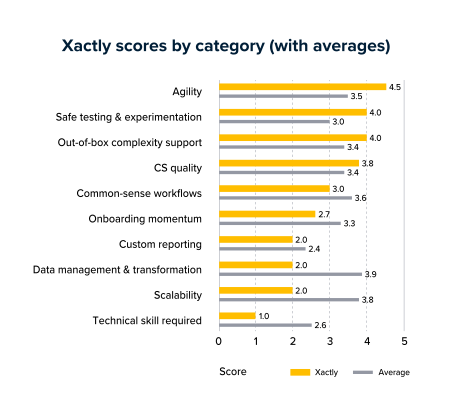
For those seeking flexibility in building and modifying incentive plans, Xactly offers strong agility, a solid testing environment, and good out-of-the-box support for complexity. However, that flexibility comes with heavy technical demands, weak data management, and limited scalability.
|
Pros |
Cons |
|
|
Flexible plan management with controlled changes
Agility is Xactly’s strongest aspect. The platform supports future-effective planning and “build now, activate later” functionality, allowing teams to prepare next year’s plans without disrupting current operations. Mid-cycle adjustments are also possible, though some changes require involvement from Xactly’s support team.
Support for complex plan mechanisms is another relative advantage. Xactly provides out-of-the-box capability for SPIFs, hierarchies, crediting models, participation changes, and rate management. Its testing and experimentation capabilities are also solid, with multiple testing environments and version control across runtime and test instances.
Technically intensive and harder to scale
Xactly struggles with technical accessibility, requiring expert-level proficiency in programming languages and workflow logic. Custom reporting carries a similar learning curve. While the functionality exists, making effective use of it demands advanced technical expertise.
Data management and scalability are notable weaknesses. Xactly lacks built-in ETL, requires data to be preconfigured before import, and depends heavily on technical expertise for transformation. Payee management is fully manual, new data points cannot be added in-tool, and changes to Salesforce integrations require paid professional services. Territory reorganizations are supported, but overall scalability is more constrained than many other vendors evaluated.
Slower rollout and average support
Onboarding momentum is also slower than average. Implementation typically takes around 5 months, with time to value averaging approximately 17 months, according to G2 data. While Xactly offers fixed implementation fees and established market presence, it doesn’t include break-fix consulting or default bespoke training.
Customer support is average overall. SLA response times are strong at the highest and lowest severity levels, but only average in between. And Xactly doesn’t define time-sensitivity requirements or guarantee resolution times for premium support.
Bottom line: Xactly provides agile plan management and good support for complex compensation mechanisms, but it demands significant technical expertise and offers weaker data management and scalability than many other CallidusCloud Commissions alternatives.
Compare Xactly and Performio head to head >>
Everstage: Fast onboarding, but limited overall
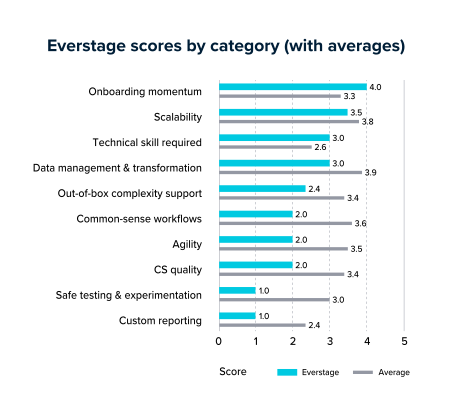
Everstage stands out for its fast implementation timelines and relatively approachable setup. However, it offers limited support for testing and reporting, and is much less flexible overall than most other CallidusCloud Commissions alternatives.
|
Pros |
Cons |
|
|
Fast path to implementation
Onboarding momentum is the primary area where Everstage excels. According to G2 data, implementation averages around two months, which is faster than any other vendor evaluated. And time to value averages around nine months, which is on the lower end as well. Everstage also provides a fixed implementation fee and complimentary break-fix consulting.
Accessibility with mixed scalability
Technical skill requirements are slightly lower than average, but Everstage still requires beginner-level programming knowledge and intermediate familiarity with workflow logic and spreadsheet formulas. For data management, it includes built-in ETL capabilities and does not require preconfiguration before import. However, transformation still depends on technical expertise, and user-defined batch processing isn’t supported.
Scalability is mixed. Everstage supports adding new payees with partial automation, adding new data points in-tool, and managing Salesforce connectors without relying on professional services. But it doesn’t support native territory reorganizations.
Limited testing, flexibility, and customer support
The most significant limitations are in testing and reporting. Everstage is the only major ICM platform evaluated that doesn’t offer a testing environment at all, and it lacks version control as well, leaving teams without a structured way to model changes before going live. Reporting functionality is also limited, with minimal in-tool capabilities that are difficult to use.
Out-of-the-box support for complex plan mechanisms is below average, with only custom hierarchies easily adjustable. SPIFs, crediting models, participation changes, and rate management either lack native support or require additional effort to configure. Workflow capabilities are restricted to multi-level approvals and don’t include dispute management or conditional logic. Agility is also limited, as the platform doesn’t support “build now, activate later” functionality for future or mid-cycle changes.
Customer support for Everstage lacks transparency. Publicly available SLA details are lacking, making it difficult to evaluate response standards in the same way as other vendors. But based on available feedback, support appears less robust than competitors.
Everstage may appeal to organizations seeking the fastest path to implementation, but it offers less depth in testing, reporting, complexity support, and agility. Teams with complex or evolving compensation structures may find its limitations increasingly restrictive over time.
Compare Everstage and Performio head to head >>
Choose the right CallidusCloud Commissions alternative
CallidusCloud Commissions earned customer loyalty for its ability to handle complex compensation structures and operate reliably at scale. Now that it no longer exists as a standalone product, many organizations are faced with choosing a modern alternative.
Some ICM solutions emphasize testing depth but demand heavy technical expertise. Others offer stronger data management or faster onboarding but provide limited support for complex plan mechanisms, workflows, or long-term agility. The right choice depends on what you prioritize—and what you’re willing to sacrifice.
Only Performio gives you the best of all worlds with no compromises. With Performio, sales leaders have direct control over their data, plans, and workflows, without relying on IT or professional services to make routine changes. Our component-based approach supports complexity at scale while keeping administration intuitive. And with industry-leading customer support, Performio comes alongside organizations to ensure their long-term success.
To see what Performio can do for your organization, request a demo today!
Read the full ICM buyer’s guide here.
Related Topics