
Everstage is one of the fastest ICM solutions to get started with: their average implementation times are some of the best in the industry. But it also doesn’t take long to realize: Everstage isn’t just missing the bells and whistles you find in other ICM software, but some of the nuts and bolts, too.
You can’t test or experiment with new plans or changes. It has extremely limited reporting capabilities. There’s no support for several common compensation plan components and workflow automations. And despite its emphasis on AI enablement and beginner-friendly technical requirements, you have to lean on your experience with coding and spreadsheet formulas for even basic tasks like creating workflows and managing data.
Whether you’re a long-time Everstage user who’s tired of the capability gaps or you’re researching ICM software for the first time, we’ve got you covered. In this article, we do a deep dive on the top five Everstage alternatives to kickstart your research.
What are the best Everstage alternatives?
The best Everstage alternatives are Performio, Varicent, CaptivateIQ, Xactly, and Salesforce Spiff, ranked by their scores on our 12-factor ICM rubric.
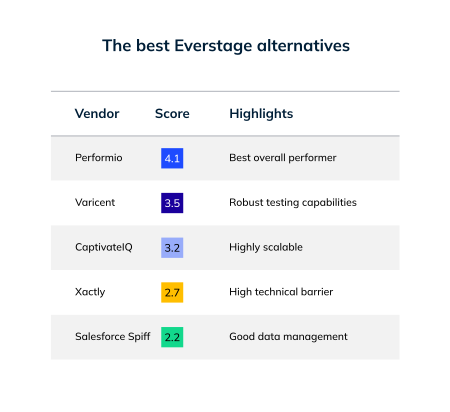
How we determined these alternatives: In 2026, we scored the most popular ICM solutions on a detailed, 12-factor rubric measuring actual ICM capabilities. (You can see exactly how the scoring system works in our ICM buyer’s guide.)
Now let’s look at all their strengths and weaknesses.
What are Everstage’s strengths and weaknesses?
| Strengths | Weaknesses |
|---|---|
|
|
Everstage has the fastest implementation time of all the top ICM solutions—just two months on average, going by G2 reviews. By the time you’ve finished implementing a more advanced tool like Varicent, Everstage has already reached time-to-value. Everstage is also one of the only vendors to offer complimentary break-fix consulting, and they have fast SLA response times at every support tier.
But when it comes to day-to-day ICM tasks, Everstage doesn’t give you much to work with. It has a drag-and-drop interface for building compensation plans, but no out-of-the-box support for SPIFs, multiple crediting models, or changing the participant module. There’s no testing environment, so if you want to experiment with changes, you have to test them on your current plan. And its custom reporting capabilities are among the weakest of the top ICM solutions.
Everstage is fast, and relatively easy to use. But once you get started, almost every one of the alternatives in our list will offer better support for building, implementing, and refining your compensation plans.
Performio: Easier to use and more advanced
Performio is the best all-around choice for ICM. It’s the only ICM solution that requires zero technical expertise to use, and it provides the best support for complex plan mechanisms and exceptions. While other top vendors have split their focus between other software categories like SPM, Performio has kept its undivided attention on ICM’s core jobs: organizing commission data, managing plans and payouts, providing transparency, and automating workflows. Which is why it does each of these with excellence.
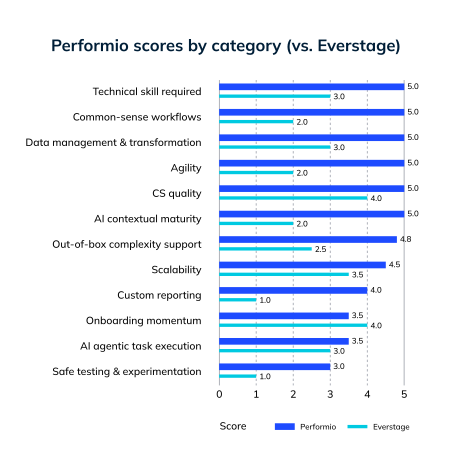
Everstage vs. Performio: Key differences
| Factor | Everstage | Performio |
|---|---|---|
| Technical skill required | 3.0 | 5.0 |
| Safe testing & experimentation | 1.0 | 3.0 |
| Custom reporting | 1.0 | 4.0 |
| Out-of-box complexity support | 2.5 | 4.8 |
| Common sense workflows | 2.0 | 5.0 |
| Data management & transformation | 3.0 | 5.0 |
| Scalability | 3.5 | 4.5 |
| Agility | 2.0 | 5.0 |
| Onboarding momentum | 4.0 | 3.5 |
| Customer service quality | 4.0 | 5.0 |
| AI contextual maturity | 2.0 | 5.0 |
| AI agentic task execution | 3.0 | 3.5 |
See how these scores were calculated >>
Everstage has slightly faster onboarding, but worse onboarding support
Everstage has a slight edge over Performio when it comes to implementation, but they both reach time to value in about 8 months. However, even in this one area where Everstage shines, Performio offers a couple of advantages Everstage lacks. It’s the only vendor that offers bespoke training and documentation by default, and it’s proven at enterprise scale: G2 named Performio Most Implementable (Enterprise) in its Fall 2026 Sales Performance Management reports.
Is Performio easier to use than Everstage?
Everstage requires beginner-level proficiency in programming languages and intermediate skills in workflow logic and spreadsheet formulas to build and modify plans, generate reports, manage your data, and write workflows. Performio doesn’t require any technical skills to access any of its capabilities.
Everstage has good customer service, Performio has the best
Everstage is known for having good customer service, but Performio is the only ICM solution that received a halo for above-average customer feedback in The Forrester Wave. It’s also the only ICM vendor that defines time-sensitivity requirements and provides guaranteed resolution times.
Everstage can’t handle complexity, Performio was built for it
Performio offers out-of-the-box support for all complex plan mechanisms and basic workflow automations, including the ones Everstage lacks. You can set SPIFs, multiple crediting models, and changes to the participant module, and most plan components can be easily adjusted in the platform. While Everstage only lets you write multi-level approval workflows, Performio also supports single transaction dispute workflows and workflows that depend on approval statuses.
Everstage is weak on testing and reporting, Performio is competent at both
When it comes to custom reporting, Everstage doesn’t have a lot to offer, and it’s difficult to use. Performio on the other hand, has the most beginner-friendly custom reporting capabilities on the market. And although Varicent has the best testing environment available, Performio has multiple testing environments and version control, giving you plenty of room to experiment and optimize—which you won’t find in Everstage.
Compare Everstage and Performio head to head >>
Varicent: More advanced (including robust testing capabilities), but harder to use
Varicent has been a leading ICM solution for more than 20 years. It’s well-suited for enterprises, and provides a platform-wide testing sandbox that makes it an appealing option for organizations that continually iterate on compensation plans. Varicent has the flexibility required to support complex plans, but it’s also one of the more technically demanding options.
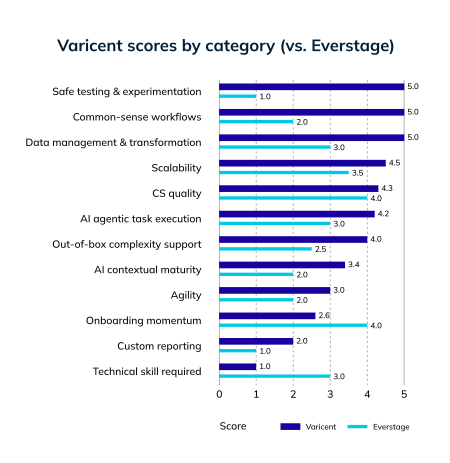
Everstage vs. Varicent: Key differences
| Factor | Everstage | Varicent |
|---|---|---|
| Technical skill required | 3.0 | 1.0 |
| Safe testing & experimentation | 1.0 | 5.0 |
| Custom reporting | 1.0 | 2.0 |
| Out-of-box complexity support | 2.5 | 4.0 |
| Common sense workflows | 2.0 | 5.0 |
| Data management & transformation | 3.0 | 5.0 |
| Scalability | 3.5 | 4.5 |
| Agility | 2.0 | 3.0 |
| Onboarding momentum | 4.0 | 2.6 |
| Customer service quality | 4.0 | 4.3 |
| AI contextual maturity | 2.0 | 3.4 |
| AI agentic task execution | 3.0 | 4.2 |
Varicent has industry-leading testing capabilities (Everstage’s testing capabilities are worst in class)
Varicent’s main strength is one of Everstage’s main weaknesses: testing. Varicent’s testing sandbox is so comprehensive that you can experiment with changes to any part of the platform without affecting your current state. Everstage, however, won’t let you test any changes in a separate environment—you can only experiment on your live plan.
Unlike Varicent, Everstage is beginner-friendly
The main advantage Everstage has over Varicent is ease of use. While Varicent is a far more capable ICM solution, it’s also far more demanding. In fact, it requires expert proficiency in both programming languages and workflow logic rules, whereas Everstage just requires beginner and intermediate skills in these areas, respectively.
This is the challenge with Varicent’s custom reporting capabilities. You can build all the reports you need, but it takes significant expertise to do so. Everstage’s custom reporting, on the other hand, is minimal and difficult to use.
Varicent is better for complex plans and large-scale operations
Varicent also offers out-of-the-box support for all complex plan components and common workflow automations. Its only drawback here is tied to Varicent’s technical overhead: once plan components are set up, they’re difficult to adjust.
When it comes to data management, Varicent was built for scale. It’s ready to ingest data out-of-the-box and supports fast, stable, high-volume batch processing. However, it lacks built-in ETL capabilities, which Everstage has.
The main gap growing organizations will notice as they scale is that Everstage doesn’t support reorganizing territories in-tool, which Varicent handles no-problem.
Varicent’s AI capabilities outclass Everstage’s
While Everstage has AI capabilities, Varicent’s are in another league, boasting the most advanced agentic AI in the field. Varicent’s AI agents have the most sophisticated plan modeling capabilities, and it’s the only solution with AI agents that take action in data processing—it can create tables and importers from natural language prompts. The only area where Everstage has an edge here is dispute management. Varicent’s AI will advise both parties through disputes, but Everstage’s agents can collect approvals and implement resolutions into payouts.
CaptivateIQ: Well-rounded, but weak on CS and agentic AI
A popular ICM provider, CaptivateIQ is best known for its simplicity and time-saving data management capabilities. Their SmartGrid system helps organizations rapidly process incentive data at scale. But implementation takes longer with CaptivateIQ than Everstage—as do customer service tasks, in general.
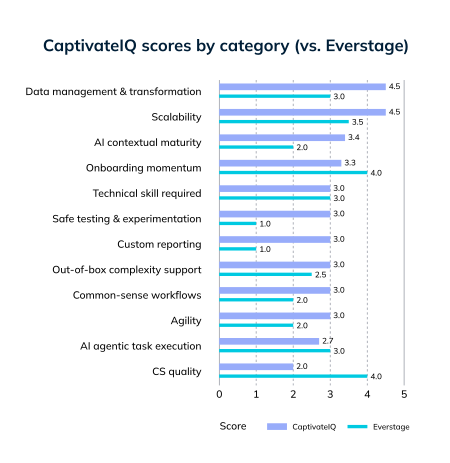
Everstage vs. CaptivateIQ: Key differences
| Factor | Everstage | CaptivateIQ |
|---|---|---|
| Technical skill required | 3.0 | 3.0 |
| Safe testing & experimentation | 1.0 | 3.0 |
| Custom reporting | 1.0 | 3.0 |
| Out-of-box complexity support | 2.5 | 3.0 |
| Common sense workflows | 2.0 | 3.0 |
| Data management & transformation | 3.0 | 4.5 |
| Scalability | 3.5 | 4.5 |
| Agility | 2.0 | 3.0 |
| Onboarding momentum | 4.0 | 3.3 |
| Customer service quality | 4.0 | 2.0 |
| AI contextual maturity | 2.0 | 3.4 |
| AI agentic task execution | 3.0 | 2.7 |
CaptivateIQ is slightly easier to use than Everstage
In most areas that matter, CaptivateIQ is on par with Everstage or better. It’s slightly easier to use, requiring only beginner-level proficiency in workflow logic rules, whereas Everstage requires intermediate-level skills. When it comes to workflow automation, CaptivateIQ has similar limitations to Everstage (you can only automate multi-level approvals), but it requires less reliance on expertise.
CaptivateIQ has the edge in reporting and testing
Building custom reports takes some technical skill in both CaptivateIQ and Everstage, but CaptivateIQ gives you significantly more freedom to generate the specific reports you need. And while both platforms used to lack a productized testing environment, CaptivateIQ released theirs in 2026—now they just need version control.
Everstage’s AI has more capabilities, CaptivateIQ’s AI has more context
Both platforms have tradeoffs when it comes to AI. CaptivateIQ’s agents are better at plan generation, and Everstage’s can be more helpful in data processing and dispute management. However, CaptivateIQ’s AI has notably more advanced contextual maturity: it understands and can interpret how the software works, as well as your sales data from other systems like your HRIS or CRM. Everstage can reference this information, but doesn’t understand how it works.
CaptivateIQ is better at data management and scalability
CaptivateIQ has a clear advantage in data management, primarily because it doesn’t require any expertise to leverage its ETL capabilities, and while Everstage has manual workarounds for its lack of batch processing, CaptivateIQ can batch publish payouts out-of-the-box.
Growing organizations will appreciate CaptivateIQ’s ability to reorganize territories—Everstage is one of the few top ICMs that doesn’t support this key component of scalability.
Everstage wins at onboarding and customer support
That said, Everstage is still worth considering for its superior onboarding and support. Everstage typically finishes implementation a month before CaptivateIQ, and reaches time to value a full quarter earlier. There’s also a substantial difference in SLA response times, with CaptivateIQ being average or slower than average at each tier, and Everstage being fast at all tiers.
Xactly: High technical barrier, but some strong capabilities
Xactly is one of the most widely recognized names in the ICM space, with a reputation for serving enterprise customers. It’s well-suited for complex compensation plans, and while it has a heavy technical demand for day-to-day ICM administration, it’s easier to adjust plans in Xactly than almost any other ICM solution.
Everstage vs. Xactly: Key differences
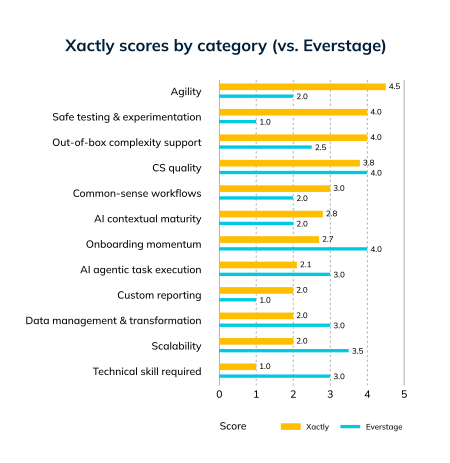
| Factor | Everstage | Xactly |
|---|---|---|
| Technical skill required | 3.0 | 1.0 |
| Safe testing & experimentation | 1.0 | 4.0 |
| Custom reporting | 1.0 | 2.0 |
| Out-of-box complexity support | 2.5 | 4.0 |
| Common sense workflows | 2.0 | 3.0 |
| Data management & transformation | 3.0 | 2.0 |
| Scalability | 3.5 | 2.0 |
| Agility | 2.0 | 4.5 |
| Onboarding momentum | 4.0 | 2.7 |
| Customer service quality | 4.0 | 3.8 |
| AI contextual maturity | 2.0 | 2.8 |
| AI agentic task execution | 3.0 | 2.1 |
Xactly trades ease of use for complexity support
Choosing Xactly over Everstage has some very clear tradeoffs. It has far better support for common plan components like SPIFs and multiple crediting models, and for making changes to the participant module. Its testing environment is second only to Varicent’s. And it’s the only option besides Performio that lets you build and adjust plans without making changes to the platform.
It’s also the hardest ICM to use. Like Varicent, Xactly requires expert-level skills in coding and workflow logic rules, but with the additional burden of intermediate proficiency in spreadsheet formulas. You can achieve highly customized reporting in Xactly, but it may require specialized technical expertise. (They do, however, have a well-rounded suite of standardized reports and configurable dashboards.)
Xactly is the least scalable of top ICMs
Scalability is another area where Xactly really struggles: it’s the only top ICM solution that requires a fully manual process for adding new payees. It’s one of the only two that doesn’t support adding new data points. And it’s the only vendor that requires total dependence on professional services to manage Salesforce Connector.
Everstage beats Xactly at data management
Everstage has a slight edge when it comes to data management. Xactly has batch processing, but no built-in ETL capabilities. Everstage has ETL capabilities, plus a manual workaround for batch processing.
Salesforce Spiff: Good data management, not much else
Spiff was acquired by Salesforce in 2024, and ever since, they’ve been building tighter integration with the Salesforce ecosystem. With the backing of the world’s leading CRM, Spiff could change significantly in the coming years. For now, data management is the main value it brings to ICM.
Everstage vs. Spiff: Key differences
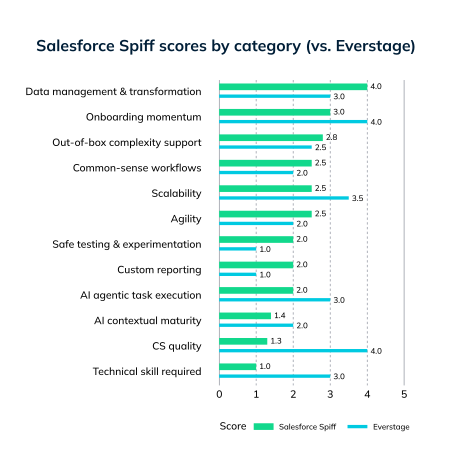
| Factor | Everstage | Spiff |
|---|---|---|
| Technical skill required | 3.0 | 1.0 |
| Safe testing & experimentation | 1.0 | 2.0 |
| Custom reporting | 1.0 | 2.0 |
| Out-of-box complexity support | 2.5 | 2.8 |
| Common sense workflows | 2.0 | 2.5 |
| Data management & transformation | 3.0 | 4.0 |
| Scalability | 3.5 | 2.5 |
| Agility | 2.0 | 2.5 |
| Onboarding momentum | 4.0 | 3.0 |
| Customer service quality | 4.0 | 1.3 |
| AI contextual maturity | 2.0 | 1.4 |
| AI agentic task execution | 3.0 | 2.0 |
Spiff is the worst alternative overall
Salesforce Spiff has some serious shortcomings. Of all the top ICMs, it scored lowest on our rubric. It’s almost as hard to use as Varicent, but without nearly as many capabilities.
Customer service is one of the main areas where you’ll see the biggest difference between Spiff and Everstage. At every service tier, Spiff has slow SLA response times, while Everstage is fast.
Spiff is barely better at testing and reporting
Spiff offers a single testing environment with no version control, making it slightly less risky than Everstage for experimenting with plan changes. When it comes to custom reporting, Spiff is marginally better: you still can’t build custom reports, but its dashboards are robust enough to partially compensate for the gap. Other Everstage alternatives are far more advanced than both of these options.
Like Everstage, Spiff lacks complexity, but plans are easier to adjust
As for out-of-the-box complexity, Spiff has the same problems as Everstage, but with one difference: once plan components are established, many are easy to adjust due to Spiff’s spreadsheet-based structure.
Spiff’s main strength is data management
There’s one aspect of ICM that Spiff does quite well: data management. Its built-in ETL capabilities aren’t quite as good as CaptivateIQ’s, but it beats Everstage at batch processing by supporting batch payout publishing.
Demo the best Everstage alternative
People choose Everstage because it’s fast and easy. But businesses can grow out of it fast, too. The more complex your sales operations, and the more you iterate, the more Everstage gets in the way.
Several alternatives do a better job supporting complex plans, automating workflows, building custom reports, testing changes, and making adjustments. But most of them force you to make tradeoffs: increasing the technical workload of day-to-day administration, or providing a worse customer experience. And of course, nobody beats Everstage at onboarding.
But there’s one Everstage alternative that makes no compromises: Performio. It’s easier to use. It’s better at handling complexity. And as AI capabilities increasingly influence how administrators work, Performio’s unmatched contextual maturity will allow it to generate outputs they can actually trust.
Request a demo today to see what Performio can do for your organization.