
When Salesforce acquired Spiff in 2024, an already popular ICM solution gained the backing of the world’s largest CRM platforms. But in the years since, there’s been little to show for it. The integration between Spiff and Salesforce Connector has improved, but Spiff also scrapped its business intelligence capabilities, and it continues to lag behind in other areas.
As ICM platforms go, Spiff works pretty well for managing your sales data. It can batch process payouts and pull data from multiple tools as needed. And while you can’t build custom reports, its built-in dashboards help compensate to a degree. Spiff’s spreadsheet-based design also makes it relatively easy to adjust most plan components.
But that’s where Spiff’s strengths end. Compared to top ICMs, it leaves a lot to be desired. Minimal testing capabilities. High technical demand. Poor complexity support. Slow customer service. In nearly every area that matters, Spiff is below average.
Whether you’re a long-time Spiff user who’s tired of the capability gaps or you’re researching ICM software for the first time, we’ve got you covered. Welcome to our deep dive on the top five Spiff alternatives.
What are the best Spiff alternatives?
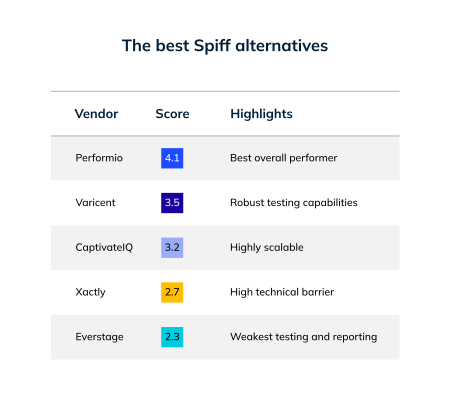
The best Salesforce Spiff alternatives in 2026 are Performio (4.1/5), Varicent (3.5), CaptivateIQ (3.2), Xactly (2.7), and Everstage (2.3), based on our 12-factor ICM rubric. Spiff scored 2.2.
How we determined these alternatives: In 2026, we scored the top ICM solutions on a detailed, 12-factor rubric measuring actual ICM capabilities. (You can see exactly how the scoring system works in our ICM buyer’s guide.)
What are Salesforce Spiff’s strengths and weaknesses?
| Strengths | Weaknesses |
|---|---|
|
|
Spiff’s main strengths are data management and convenience for Salesforce customers. Its weaknesses are high technical demand, limited testing, no custom reporting, weak out-of-the-box complexity support, and slow customer service.
Spiff is part of the Salesforce ecosystem, making it a convenient choice for businesses that already have Salesforce tools in their tech stack. Additionally, while most ICMs have either built-in extract, transform, load (ETL) capabilities or batch-processing support, Spiff is one of the few options that has limited versions of both crucial processes.
Beyond that, most competitors outclass Spiff on every criteria. It requires expert-level skills in SQL and other programming languages. It only has a single testing environment with no version control, making plan experimentation both limited and risky. Sales admins can’t generate custom reports. There’s no out-of-the-box support for building custom hierarchies, creating multiple crediting models, or managing rates. It’s missing key workflows like single transaction disputes and status-based approvals. Building and adjusting plans requires changes to the platform. Their customer service is slow at every service level. And they’re behind in AI capabilities as well.
Spiff can seem like an appealing choice because it’s tied to one of the most recognizable enterprise software brands in the world. But any of the top ICM alternatives would be a stronger overall choice, and some don’t even require you to make tradeoffs.
Performio: Better in every way
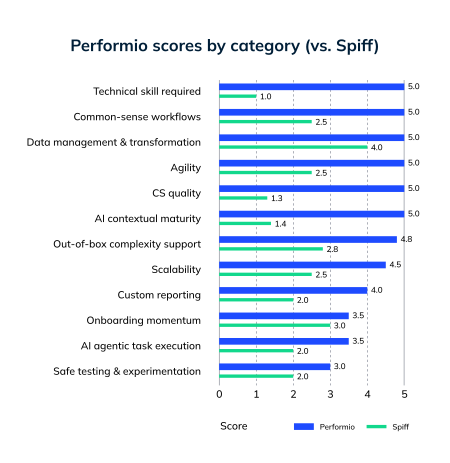
Performio isn’t just well-rounded—it’s the all-around best choice. It has the strongest support for complex plan mechanisms and doesn’t require any technical expertise to use. Its unique component-based architecture lets businesses of all sizes build and modify incentive plans with ease. And Performio scored 5.0 on AI contextual maturity, the highest of the six ICMs we reviewed, giving it the strongest foundation for AI capabilities.
Spiff vs. Performio: Key differences
See how these scores were calculated >>
Performio is far easier to use than Spiff
Spiff is one of the most technically demanding ICM solutions on the market, requiring expert-level skills in programming languages, intermediate proficiency in spreadsheet formulas, and some experience with workflow logic rules.
Performio is the only ICM option that requires no familiarity with programming, formulas, or logic rules. You can access its full range of capabilities without any technical expertise.
Spiff is weaker than Performio on testing and reporting
With just a single testing environment and no version control, Spiff makes it difficult to experiment with changes to your incentive plans. And while its built-in dashboards are high quality, Spiff doesn’t provide a way for admins to build custom reports.
Performio, on the other hand, has multiple testing environments with version control in both runtime and testing. It also has the easiest custom reporting process of all the top ICMs we reviewed.
Spiff limits flexibility, Performio was built for it
When it comes to support for complex plan mechanisms and workflow automation, Spiff is decent. It supports SPIFs and lets you make changes to the participant module out-of-the-box, which some tools can’t handle. And its spreadsheet-based architecture makes it easy to adjust custom hierarchies, plus you can freely change crediting models and rates as needed. And writing workflows in Spiff doesn’t require technical expertise. But you’re limited to one type of workflow: multi-level approvals.
Performio’s component-based architecture supports every type of complex plan mechanism out-of-the-box: SPIFs, custom hierarchies, multiple crediting models, and changes to the participant module or rates. Performio is also one of the only two ICMs that supports automation for all common workflows, including single transaction disputes and status-based workflows. So for complex incentive plans, Performio is the clear choice.
Unlike Performio, Spiff struggles with scalability and agility
As your sales organization grows, Spiff gets in the way—you need technical expertise or vendor support to add new data points, and you can’t reorganize territories in the tool itself. Performio fully supports both of those processes, no technical skill required. And while Spiff lets you build new plans and adjust current ones, it requires changes to the platform, and you can’t schedule adjustments to take effect on a future date. Performio lets you freely build and adjust plans without changing the software.
Spiff’s AI lags behind Performio’s
Spiff scored lower than every other competitor when it came to AI contextual maturity and agentic task execution. Their AI understands the least about your unique context, and it supports essential use cases in fewer ways. Performio AI, however, is the only AI that has the complete context of your software, your data, your business, and how those three areas relate. In other words: its outcomes are the most reliable. And its AI agents are toward the front of the pack with plan generation capabilities and the ability to take action in payout disputes.
Spiff vs. Performio: The bottom line
Performio has the advantage over Spiff in every point of comparison. It’s easier to use. It’s better for complex plans. It’s better for building, adjusting, testing, and reporting on plans. It has the capabilities it needs to scale with your organization. And its AI is significantly more useful. Spiff has the brand recognition of Salesforce behind it, but that hasn’t manifested in any major strengths yet.
Varicent: Better capabilities and AI, similar technical demand
Varicent has been one of the biggest names in ICM for more than 20 years. Widely known for its best-in-class testing sandbox and strong support for complex enterprise plans, Varicent is a popular choice. But as with Spiff, getting the full value of its capabilities depends on your technical expertise—it’s one of the most demanding tools on the market.
Spiff vs. Varicent: Key differences
See how these scores were calculated >>
Spiff and Varicent have some similar flaws
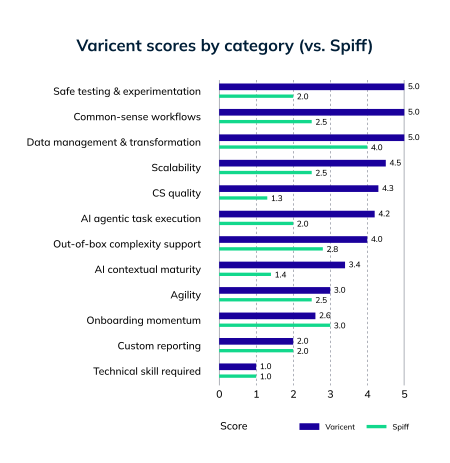
Varicent demands the same expert-level skills in programming languages as Spiff, with the additional burden of expert proficiency in workflow logic. And while unlike Spiff, Varicent does support custom reporting, this is an area where users feel the most technical demand. Custom reporting is possible, but takes a lot of work.
Varicent’s testing is best-in-class, Spiff leaves a lot to be desired
Varicent is the only ICM with a platform-wide testing sandbox. You can comfortably experiment with changes to just about anything without impacting your current system. You also get version control in both runtime and testing, so you always know who changed what. Spiff’s single testing environment and total lack of version control makes it poorly suited for testing safely.
Varicent is better equipped to serve enterprises
Varicent supports complex plans and workflows out-of-the-box, while Spiff only has limited capabilities in these areas. It’s worth noting, however, that adjusting plan components in Varicent does take some expertise.
When it comes to data management, Spiff is strong, but Varicent is stronger. It’s ready to ingest data out-of-the-box and is known for fast and stable high-volume transaction processing. And unlike Spiff, Varicent supports user-defined, granular batch processing.
Enterprises will also appreciate Varicent’s fast response times at all SLA tiers, whereas Spiff is slower-than-average at all tiers.
Varicent has far stronger agentic AI capabilities
Varicent’s agentic AI is more advanced than other ICMs in two main ways:
-
Its agents take action in data processing, creating tables and importers from natural language prompts.
-
Its plan modeling agents can recommend actions to achieve specific outcomes and proactively suggest ways to improve a plan.
Varicent’s AI also generates incentive plans from prompts. Spiff’s AI is less advanced in almost every area we compared them, with the exception that both vendors’ AIs can advise admins and reps in payout disputes.
Spiff vs. Varicent: The bottom line
Capability-wise, there’s really no reason to choose Spiff over Varicent. They’re both difficult to use, but Varicent rewards your efforts with far more capabilities. Varicent is an industry leader in both testing and agentic AI, while Spiff’s biggest selling point (besides being part of Salesforce) is its data management capabilities—and Varicent outperforms Spiff there, too.
CaptivateIQ: Simpler to use, but with similar limitations
CaptivateIQ is yet another Spiff alternative with few (if any) tradeoffs. A well-known ICM provider, CaptivateIQ is often selected for its simplicity and scalability. Its SmartGrid system makes it easy to quickly process incentive data at scale. And while CaptivateIQ’s customer service is slow at some service levels, overall, customers can expect faster response times than they’ll get with Spiff.
Spiff vs. CaptivateIQ: Key differences
See how these scores were calculated >>
CaptivateIQ is significantly easier to use than Spiff
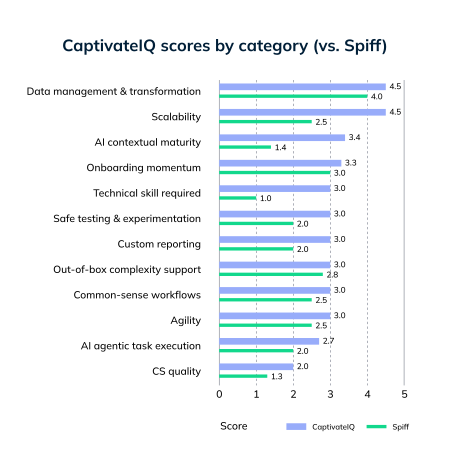
CaptivateIQ is far more beginner-friendly than Spiff. It only requires a basic understanding of programming languages and workflow logic, with intermediate experience in spreadsheet formulas—whereas Spiff takes expert-level programming skills and intermediate experience with formulas. In day-to-day ICM tasks, sales administrators will feel the difference.
CaptivateIQ is slightly better for testing and reporting
Like almost every other competitor, CaptivateIQ has stronger testing capabilities than Spiff. However, like Spiff, it only has a single testing environment with no version control. But this is an area they’re currently developing. When it comes to reporting, CaptivateIQ lets admins build all the custom reports they need, as long as you know your way around some intermediate spreadsheet formulas.
CaptivateIQ and Spiff have shared weaknesses
For complex incentive plans, Spiff and CaptivateIQ are pretty on par with each other. Both make it easy to adjust components like custom hierarchies, crediting models, and rates once they’ve been set up, but they have some limitations when it comes to what components you can set up yourself in-tool. And while Spiff is easy to adjust because of its spreadsheet-based design, it’s not quite as elegant—for example, when managing rates, you can’t enforce continuous rates and may have gaps between rate tables. However, it lets you make changes to the participant module, which CaptivateIQ doesn’t support.
Both tools are also comparable for workflow automation. They each only support multi-level approval workflows, though Spiff is slightly worse due to its deprecated Docusign workflows—it’s harder to collect signatures in your ICM system if you’re using Spiff.
CaptivateIQ’s AI is significantly more advanced than Spiff’s
CaptivateIQ’s AI is above average when it comes to contextual maturity and agentic task execution. It understands both your sales data and your software, while Spiff’s is merely aware of how the software works and unaware of how your specific tools (CRM, HRIS, etc.) and sales data should inform its outputs. For actual AI use cases, the main difference is that CaptivateIQ can actually generate incentive plans based on prompts, and Spiff isn’t there yet.
Spiff vs. CaptivateIQ: The bottom line
CaptivateIQ is a step up from Spiff, but shares some of its drawbacks. You’ll trade Spiff’s quality built-in dashboards for the freedom of custom reporting. And while CaptivateIQ is generally much easier to use, you’ll still be limited by its lack of complexity support and workflow automation. But most organizations will find CaptivateIQ to be a better overall experience than Spiff.
Xactly: A more advanced option with major tradeoffs
Xactly is a reputable ICM and a common choice for enterprises. Like Spiff, Xactly comes with a heavy technical demand for day-to-day ICM administration, but it’s easier to adjust plans in Xactly than most ICMs. Its strengths are handling complexity and testing, but it struggles with data management, where Spiff is above average.
Spiff vs. Xactly: Key differences
See how these scores were calculated >>
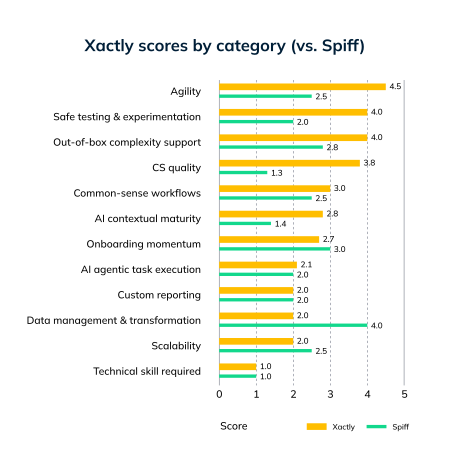
Both Spiff and Xactly are weak on ease of use and reporting
Xactly is the most technically demanding of all the top ICMs—it’s even harder to use than Varicent. It takes expert proficiency in programming and workflow logic, plus intermediate skills with spreadsheet formulas. And while Spiff and Xactly scored similarly low in custom reporting, it was for different reasons. Xactly does let admins build custom reports, but like Varicent, it takes significant expertise to do so. So Spiff doesn’t let you generate custom reports, and Xactly has a steep barrier to entry.
Xactly has the testing capabilities Spiff lacks
The only ICM that’s better at testing than Xactly is Varicent. When it comes to safely experimenting with plan changes, Spiff pales in comparison to Xactly. Like Performio, Xactly has multiple testing environments with version control in both runtime and testing, but its sandbox is broader, giving you even more flexibility to model new ideas.
Spiff is much better at data management and scalability than Xactly
Of all the top ICMs, Xactly is the weakest on data management and transformation. It’s the only ICM we reviewed that requires your data to be preconfigured before you can import it. Once you’ve imported your data, managing and transforming it requires technical expertise, and there are no built-in ETL capabilities. It does, however, support user-defined batch processing without the limitations of Spiff.
Xactly is also surprisingly poor at scaling. It’s the only ICM we reviewed that has a fully manual process for adding new payees, and it’s also the only vendor that requires customers to rely on professional services to manage the Salesforce Connector. It does allow you to reorganize territories in-tool, but as your organization grows, Xactly makes scaling your incentive plan a challenge.
Xactly is far more agile than Spiff
Xactly is one of the most agile ICMs on the market, second only to Performio. You can build next year’s plan or adjust your current one without making any changes to the platform itself, and you can activate your plan immediately or schedule it for the future. Xactly’s only shortcoming in this area is that you can’t make adjustments in the tool itself.
Spiff vs. Xactly: The bottom line
Xactly is one of the only top Spiff alternatives that actually comes with drawbacks. It’s much better at handling complex incentive plans, building and adjusting plans, and testing changes. They also have faster customer service and more developed AI. But Spiff has significantly better data management capabilities and isn’t quite as cumbersome as you scale.
Everstage: Faster onboarding, but not much better
Everstage is a popular ICM that’s best known for its ease of use and fast implementation. Nobody beats them at onboarding—Everstage reaches time-to-value before some ICMs have even finished implementation. But it also lacks key features, including some that you’ll find in Spiff. It’s worth considering, but like Xactly, choosing Everstage comes with some tradeoffs.
Spiff vs. Everstage: Key differences
See how these scores were calculated >>
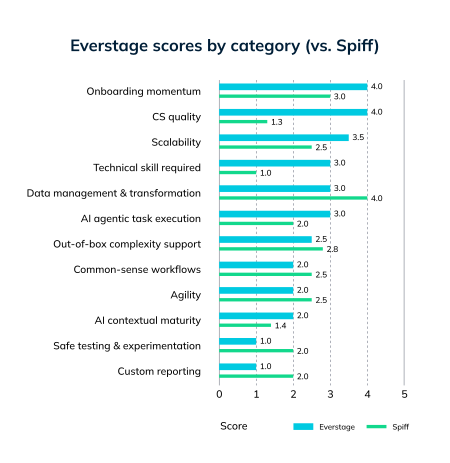
Everstage is easier to use than Spiff, but lacks key capabilities
Everstage is far more approachable than Spiff. You’ll need intermediate experience with workflow logic and spreadsheet formulas, but just beginner-level skills in programming. It’s about as easy to use as CaptivateIQ.
But while it’s easier than Spiff, you also can’t do as much—Everstage is the only ICM that scored worse than Spiff in complexity support and common-sense workflows. It does support custom hierarchies and rate management out-of-the-box, which Spiff can’t do, but while most plan components are easy to adjust in Spiff, Everstage only lets you easily adjust custom hierarchies. Everstage is also the only top ICM besides Xactly that requires technical skills to automate workflows.
Everstage has faster onboarding and customer service than Spiff
For companies that need to get up-and-running fast, Everstage is one of the best options available. Implementation takes about two months on average (compared to six months or more with Spiff), and customers typically reach time-to-value in about eight months (compared to 9–12 with Spiff). They’re also the only vendor besides Performio to provide complementary break-fix consulting during the onboarding process.
Everstage is also well-known for exceptional customer service—which Spiff lacks. Spiff has slower-than-average response times at every service tier, while Everstage provides faster-than-average responses at every tier.
Everstage is worse than Spiff at testing and custom reporting
Spiff’s testing and custom reporting capabilities are significantly worse than most top ICMs. But Everstage’s are basically non-existent. It doesn’t have a single testing environment, so any changes you want to make, you have to make directly to your live build, without version control of any kind. Everstage does technically have a custom reporting function, but it’s so difficult to use that you’re probably better off with Spiff’s built-in dashboards.
Neither is great in this area, but Everstage is in last place.
Spiff is better for data management and building new plans
Everstage has some decent data management capabilities, but it’s held back by the fact that you have to make changes to the software in order to use them. It has built-in ETL capabilities and a manual workaround for batch processing, but Spiff takes the edge here for making it easier to manage your data.
As you plan for the future, Spiff has a slightly better system for building next year’s plan because you can schedule it to take effect at a future date. However, neither vendor lets you schedule changes to your current plan.
Spiff vs. Everstage: The bottom line
There are legitimate reasons to consider Everstage over Spiff, but it’s not much of an improvement in most areas, and those improvements come at a cost. If you’re making a switch, you’ll appreciate the change of pace in customer service and find it easier for day-to-day administration, but you’ll also be taking a step backward in testing, reporting, and data management.
Demo the best Spiff alternative
People choose Spiff because it’s part of the Salesforce ecosystem and works well for managing sales data. But when you see how it compares to other leading ICMs, it’s hard to justify investing in a below-average tool.
Several top ICM vendors are all-around better options than Spiff. Only a couple of choices are harder to use, and half of the alternatives are even better than Spiff at data management—its only real strength.
But there’s one Spiff alternative that clearly stands above the rest: Performio. It’s vastly easier to use. It’s significantly better at handling complexity. And as AI capabilities increasingly influence how administrators work, Performio’s unmatched contextual maturity will allow it to generate outputs they can actually trust.
Request a demo today to see what Performio can do for your organization.
Related Topics