CaptivateIQ is a popular solution for incentive compensation management (ICM), sales performance management (SPM), and sales planning. But popular doesn’t mean best. And there are some better alternatives.
CaptivateIQ is easy to get started with, but it isn’t very flexible, and lacks some basic ICM components. As your organization grows and your sales plans increase in complexity, CaptivateIQ becomes unwieldy—requiring custom code or vendor support to set up SPIFs, custom hierarchies, or multiple crediting models. And while sales leaders and ICM professionals often test changes or new models before implementing them, CaptivateIQ hasn’t even productized a testing environment yet as of 2025.
Maybe you already have CaptivateIQ, and you’re tired of these challenges. Or perhaps you’re just vetting whether this popular choice is the right one for you. As an ICM provider, we know it’s hard to compare these tools—even G2 reviews can make the options all look about the same. To help you make an informed choice, we created a thorough rubric for evaluating ICM solutions and exploring their actual strengths and weaknesses. You can see the scores of every major ICM solution in our 2026 ICM rankings list—and if you want a detailed understanding of how the scoring system works, check out our buyer’s guide.
Here’s a quick peek at the best CaptivateIQ alternatives:
In this article, we’ll take a closer look at these alternatives to CaptivateIQ Incentives, focusing on the key differences with a side-by-side comparison that highlights the capabilities and factors that will most affect your experience.
CaptivateIQ strengths and weaknesses
| Strengths | Weaknesses | Alternatives, ranked |
|---|---|---|
|
|
|
See how these rankings were calculated in our ICM Buyer's Guide >>
CaptivateIQ Incentives is one of the faster ICM solutions to implement—their team will have you up-and-running in about 3 months on average, based on the G2 user experience. In general, it’s easier to manage your data in CaptivateIQ than with some of their competitors. It takes less technical expertise, and the software has built-in extract, transform, and load (ETL) capabilities.
But it comes with plenty of drawbacks, too. Without a built-in testing environment, you’re stuck experimenting with potential compensation models and plan adjustments somewhere else. CaptivateIQ wants you to buy and learn another product for a process that should be baked into your ICM software. And as we mentioned before, while CaptivateIQ doesn’t require as much expertise or experience to use, it doesn’t support many plan components out-of-the-box. You can add them, but only with coding or help from CaptivateIQ.
And unfortunately, their support leaves a lot to be desired. Compared to other top ICM solutions, their SLA response times are slow or merely average across all issue severity levels. They also don’t define requirements for expedited service or provide guaranteed resolution times at higher service levels.
CaptivateIQ alternatives
The best alternatives to CaptivateIQ are Performio, Varicent, Xactly, and Everstage. Most of these options are strong in the areas where CaptivateIQ struggles, particularly with built-in testing and experimentation. But some require you to sacrifice CaptivateIQ’s ease of use for this functionality. One choice, however, beats or ties CaptivateIQ Incentives on every criteria.
Performio: For every sales plan and every user
Performio is a dedicated ICM that combines unparalleled accessibility with uncompromising capabilities—and it’s the best CaptivateIQ alternative. With a unique component-based approach to building compensation plans, Performio ensures that administrators can easily create and modify complex sales plans without breaking formulas, relying on simplistic rules-based models, or needing outside help. It’s a truly self-service solution, and our vision has never strayed from ICM to encompass SPM or sales planning.
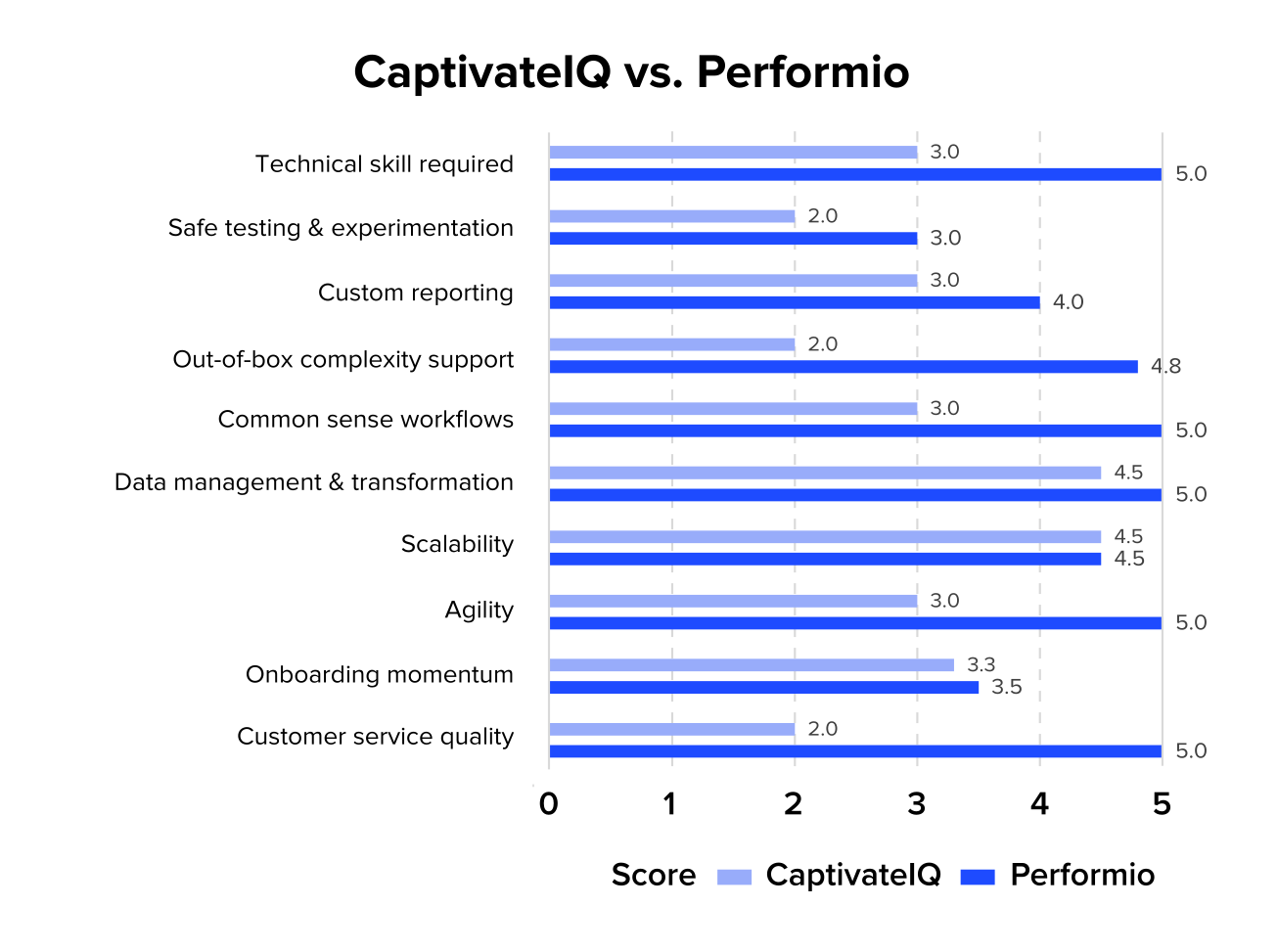
In nearly every category, Performio outclasses CaptivateIQ. Consider ease of use: Performio requires no coding, no workflow logic, and no formulas. CaptivateIQ is easier to use and learn than some leading ICM solutions, but to get the most mileage from it, you still need coding expertise, some proficiency in workflow logic, and intermediate knowledge of spreadsheet formulas.
Performio also supports multiple testing environments and version control in both testing and runtime, while CaptivateIQ Incentives doesn’t offer a testing environment at all. Performio also requires less technical experience to generate custom reports and offers out-of-the-box support for ICM components and adjustments like SPIFs, custom hierarchies, multiple crediting models, and changing the participation module. CaptivateIQ lets you adjust some of these with coding, formulas, or support, but SPIFs are difficult to adjust.
In terms of ICM workflows, Performio supports multi-level approvals, single-transaction disputes, and approval status-based conditional workflows, while CaptivateIQ only supports multi-level approvals.
When you want to modify a plan, Performio is one of the only ICM solutions that lets you make changes to your plan without requiring changes to the platform itself. CaptivateIQ inhibits your agility with a more complex modification process.
And while CaptivateIQ is weak in customer service, Performio offers a premium experience with guaranteed resolution times, clear criteria for expedited service, and support for issues with nonscaling workarounds. Plus, we were the only ICM recognized with a halo for above-average customer feedback in the 2025 Forrester Wave Report.
There are three areas where CaptivateIQ and Performio are comparable solutions: data management, scalability, and onboarding. And upon closer inspection of the underlying criteria in those three areas, Performio has the edge there, too.
CaptivateIQ doesn’t support batch calculations, and it’s a live application—you can’t process batches in a test environment. And while CaptivateIQ is highly scalable, you have to manually add payees as your organization grows, plan attributes don’t sync when you add new datapoints, and the Salesforce Connector requires some vendor support. None of that is the case with Performio.
CaptivateIQ takes about a month less to implement on average (3 months vs. 4 months), but the time-to-value is significantly slower (15 months vs. 8 months). You also have to pay extra for bespoke training and documentation, which comes standard with Performio. CaptivateIQ doesn’t have complementary break-fix consulting like Performio, and they’re not equipped to support enterprise customers like Performio.
Bottom line: Performio isn’t just the best alternative to CaptivateIQ—it’s an all-around better ICM solution. In every area that matters to ICM, Performio delivers a simpler, higher-quality experience.
Varicent: More advanced, harder to use
Varicent has been a leading ICM provider for 20 years. Within the last few years, they’ve concentrated their focus on SPM, and currently offer three distinct sales products: Incentives, Sales Planning, and Stellar Insights. Most known for its robust capabilities and praised for its flexibility, Varicent is worth considering as an alternative to CaptivateIQ.
See the full CaptivateIQ vs. Varicent breakdown >>
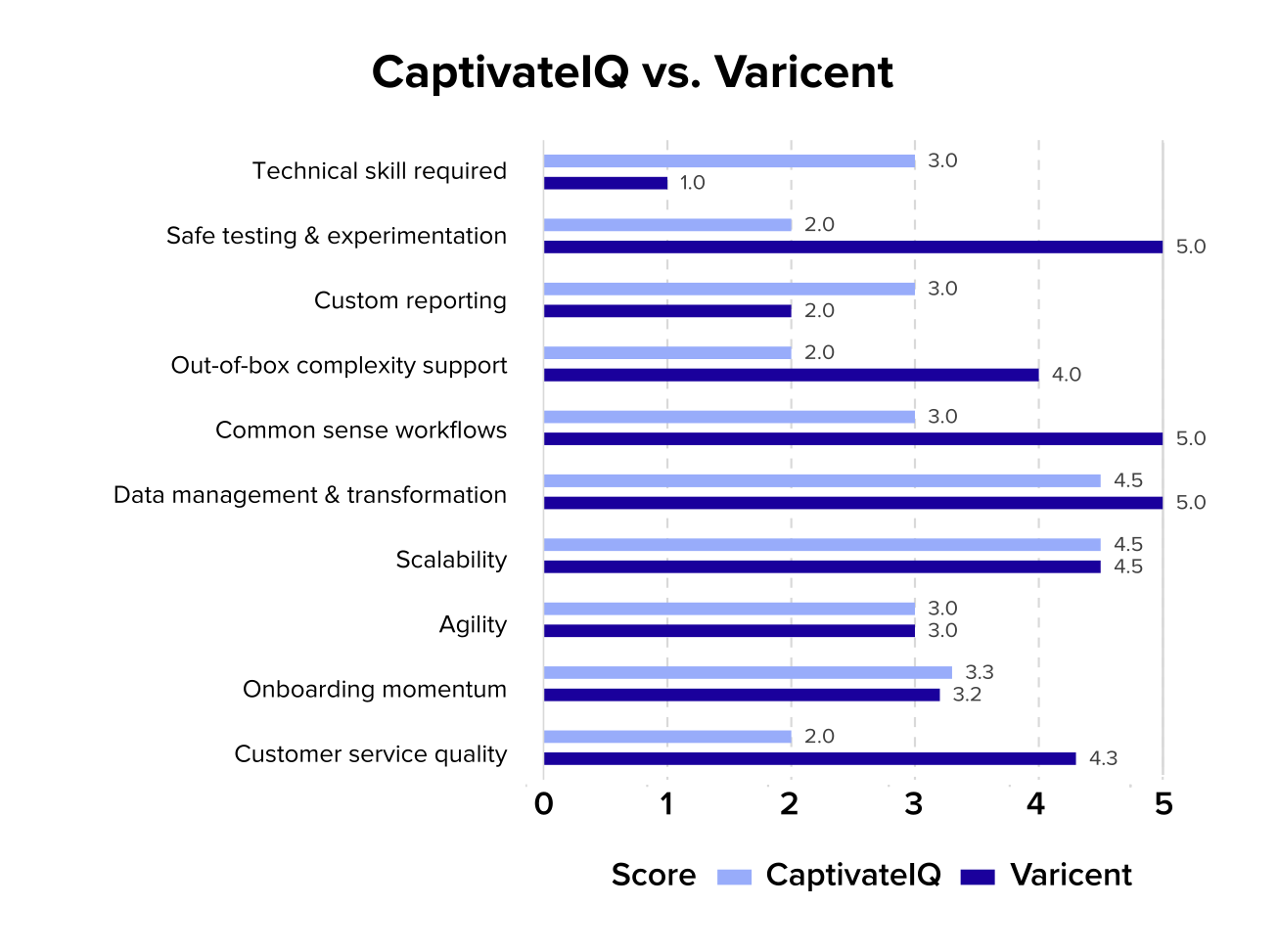
Varicent and CaptivateIQ are comparable solutions in several core areas, but the difference is pretty straightforward: you can do more with Varicent, but it’s harder. Varicent’s greatest weakness (and most cited critique in G2 reviews) is its complexity. It requires expert-level proficiency in coding and workflow logic, making CaptivateIQ the better choice in terms of ease of use. Varicent is also not as strong when it comes to reporting, where again, it’s held back by its complexity. Both tools support custom reporting, but it’s easier to do in CaptivateIQ.
In every other area, however, Varicent is on par with CaptivateIQ or noticeably better. Testing is a weakness of CaptivateIQ, and it’s arguably Varicent’s greatest strength. CaptivateIQ doesn’t support common ICM mechanisms out-of-the-box, but Varicent does. And while CaptivateIQ has notable gaps in basic ICM workflows like single-transaction disputes and approval-status based conditionals, Varicent has you covered.
And then there’s customer service. Varicent offers fast response times at every service level, while CaptivateIQ is average or slower-than-average. And Varicent’s support includes problems with nonscaling workarounds, which CaptivateIQ’s does not.
Bottom line: Varicent trades convenience for power. It can handle complex incentive structures and compensation plans just fine, but even some of the basics will take a higher level of expertise.
Xactly: More flexibility, but with more gaps
Xactly has five distinct sales management products for ICM, SPM, and sales planning, but we’ll focus on Xactly Incent. The platform has earned several top positions in the G2 Enterprise Grid Report based on its popularity and customer reviews.
See the full CaptivateIQ vs. Xactly breakdown >>
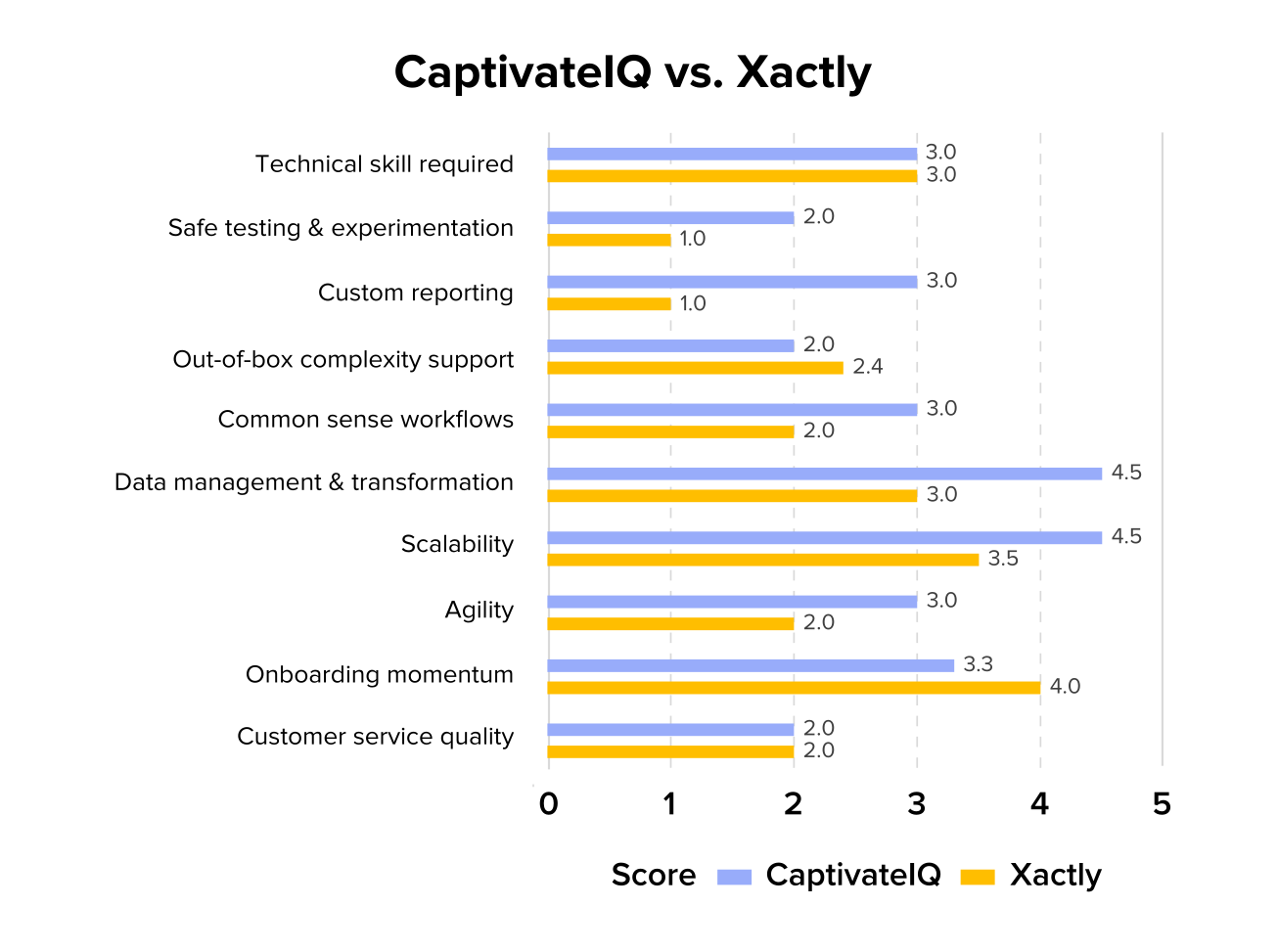
In general, CaptivateIQ is more balanced than Xactly in the factors that most impact ICM. But each of its three main weaknesses (testing, out-of-the-box complexity, and customer service) are areas where Xactly is quite good.
Xactly has multiple testing environments with version control in both testing and runtime environments. You can build plans with SPIFs, custom hierarchies, and multiple crediting models and make changes to the participation module out-of-the-box (unlike with CaptivateIQ). You can also prepare next year’s plan or make adjustments to your current plan without having to make tweaks to the platform, making Xactly a more agile option. And you can expect their customer service to provide faster response times, with SLA level 2 including issues that have nonscaling workarounds.
On the other hand, Xactly requires expert level proficiency in programming languages and workflow logic. And you’ll need to draw on that expertise to build and run custom reports as well. With CaptivateIQ, you can get by with some basic data modeling or SQL and a rudimentary understanding of workflow logic.
Interestingly, “ease of use” is by far the most common thing customers praise Xactly for in G2 reviews. This may reflect a more technical userbase, or perhaps, many users find that the out-of-the-box functionality is sufficient, so they don’t encounter Xactly’s technical challenges.
Bottom line: Xactly might be a good alternative for CaptivateIQ if you want a solution that does what you need out-of-the-box, lets you test changes and future plans, and comes with better support. But choosing Xactly will force you to make a lot of compromises, and you’ll need significantly more technical expertise to address them.
Everstage: Fastest to get started with but the most limited
Everstage is a fully AI-enabled sales management platform. Artificial intelligence is baked into each of their tools and uses AI assistants and agents to analyze your data and make recommendations. Everstage Incentives is built for non-technical users, and has the fastest implementation time of the ICM solutions we reviewed.
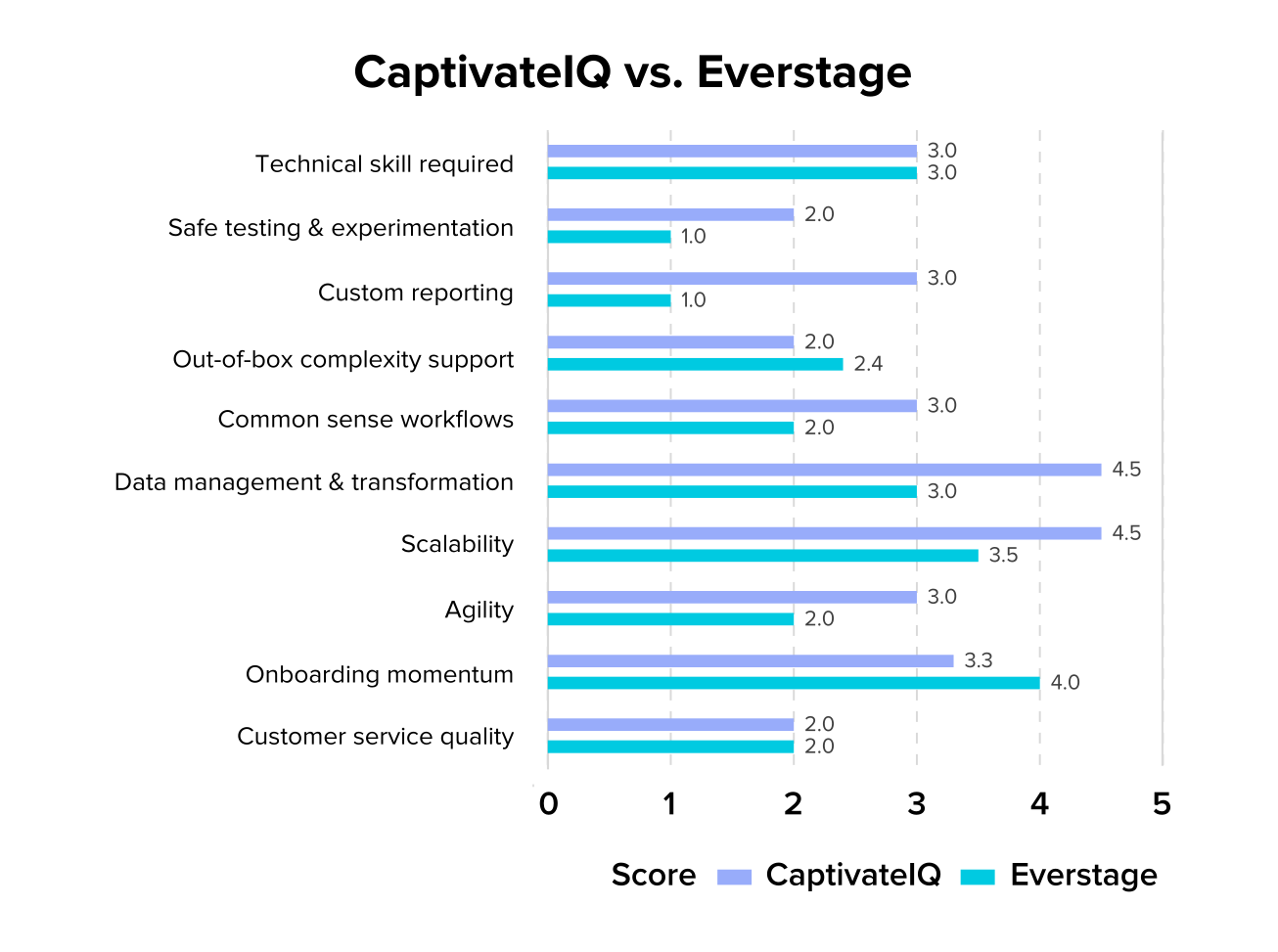
Everstage scored worse than CaptivateIQ on all but three criteria: out-of-the-box complexity support (where it was still not good), onboarding momentum, and customer service (which was a tie). Everstage supports custom hierarchies out-of-the-box, and that’s really the only advantage in the complexity category.
The only true strength of Everstage using our ICM criteria is onboarding, where it scored the highest of any solution. Their average implementation time is one month faster than CaptivateIQ, their time-to-value is six months faster, and they offer complementary break-fix consulting, which CaptivateIQ doesn’t have.
Everstage is a pretty accessible solution, but unfortunately, it’s one of the only options that requires technical expertise to write workflows and to manage and transform your data. Of the five ICM solutions we evaluated, it also had the most limited reporting capabilities (and they’re hard to use).
In terms of scalability, Everstage is fairly similar to CaptivateIQ, but with one glaring hole: it’s the only solution of the five that doesn’t support reorganizing your territories. Which may be a problem as your organization grows and changes over time.
And when it comes to building future plans or making changes to your current one, Everstage can do it, but it was also the only one of the five that doesn’t support building a plan or change now and activating it later.
Bottom line: There are very few situations where Everstage is a better choice than CaptivateIQ. You may be able to get started faster, but it lacks capabilities that all the other top solutions have in common. Fortunately, there are stronger CaptivateIQ alternatives available that address CaptivateIQ’s weaknesses with fewer tradeoffs.
Choose the ICM software that’s right for you
CaptivateIQ is easy to use, but Performio is even easier. And more importantly, there’s more you can do with it. The larger and more complex your incentive plans become, the more challenging CaptivateIQ is to work with. Performio gives you full control over your plan and complete freedom to create the structures and incentives that best align with your revenue goals—whereas CaptivateIQ may govern what structures and incentives you can use effectively.
Alternatives like Varicent and Xactly are more advanced than CaptivateIQ in several important ways, but they’re also more technically demanding. Performio is the only CaptivateIQ alternative that combines ease of use with flexibility. Our component-based architecture allows you to scale and make adjustments without breaking formulas or violating rules.
Performio excels in the same areas CaptivateIQ does, and delivers greater access to the advanced capabilities you need to keep your incentives and goals aligned.
To see what Performio can do for your organization, request a demo today!
Read the full buyer’s guide here.

Mark Kemp is a seasoned leader with over 20 years of global experience in the Incentive Compensation Management (ICM) and Sales Performance Management (SPM) space. Now serving as Chief Customer Officer at Performio, Mark is recognized as a trusted expert in the industry. He has worked with major players around the world, bringing deep insight into customer needs, operational complexity, and the technology that powers performance. His unmatched expertise and leadership make him a key voice in shaping the future of ICM and SPM.