We scored the leading commission tracking software options on a scale of 1–5. Here are the overall scores:
- Performio (4.1)
- Varicent (3.5)
- CaptivateIQ (3.2)
- Xactly (2.7)
- Everstage (2.3)
- Salesforce Spiff (2.2)
Read on to learn the pros and cons of each.
As sales organizations grow, tracking commissions with spreadsheets starts to create more problems than it solves. Commission plans get complicated fast, and the more sales reps you have, the more individual payouts and activities you need to calculate and record. Of course, every rep also expects to have accurate, up-to-date commission data on hand.
That’s where commission tracking software comes in.
Commission tracking software integrates with CRM systems to automatically calculate commission payouts according to your incentive compensation plan. Sales admins use these tracking tools to connect deals won to commissions earned, monitor projected incentive spend, manage disputes, and generate reports. Commission tracking software often allows admins to build, test, execute, and modify sales commission plans.
Sales reps check commission tracking software regularly to see their progress toward goals, set their payout expectations, and understand the relationship between their work and their earnings.
But not all commission tracking software is equally suited to the task. Some overemphasize simplicity and struggle to support complex commission structures. Others may be flexible enough to implement highly sophisticated compensation plans, but so cumbersome and technical that admins struggle to make changes themselves. And if reps don’t feel comfortable using it, they’ll resort to shadow accounting and wind up frustrated. So it’s important to choose the right one.
Two of the most important areas of comparison for modern commission tracking software are custom reporting capabilities and AI capabilities. Many solutions require vendor support or significant technical expertise to build and generate custom reports, making them far less useful for commission tracking. And built-in, contextually-aware AI vastly improves accessibility and dispute processes, giving sales reps fast, accurate explanations of every payout based on how your plan actually works and the sales activities they’ve logged.
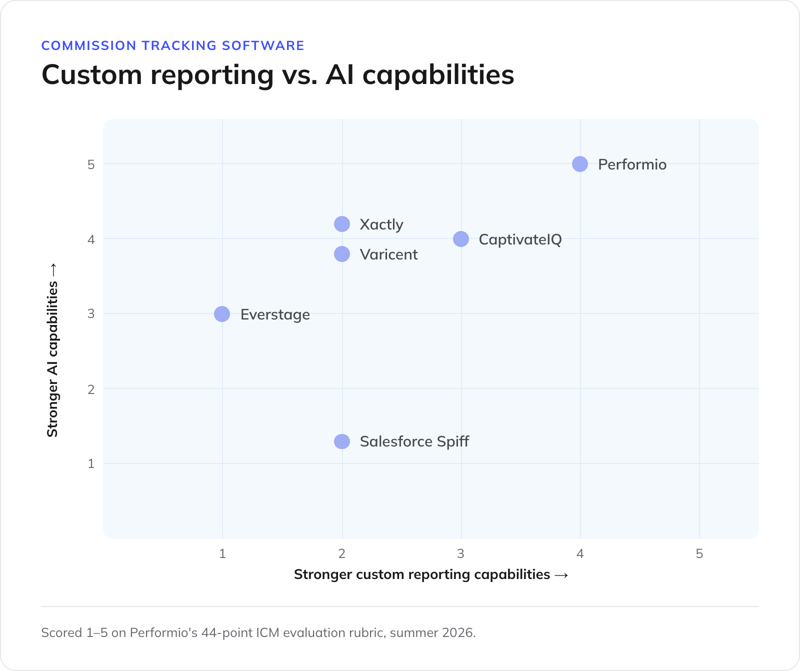
For the best balance of custom reporting and AI capabilities, there are two clear leaders:
- Performio is the best of both worlds with the most mature, contextually aware AI (Gartner even called attention to it in The Magic Quadrant for Sales Performance Management 2026) and advanced custom reporting capabilities that require zero experience in programming or familiarity with workflow logic and spreadsheet formulas.
- CaptivateIQ is a distant second with AI that can advise admins through disputes but not actually take action, and advanced reporting that requires intermediate technical expertise.
Now let’s get into how the top six commission tracking software solutions compare based on their actual capabilities.
- Performio
- Varicent
- CaptivateIQ
- Xactly
- Everstage
- Salesforce Spiff
How we ranked the top commission tracking software solutions
By now you probably noticed: we gave ourselves the highest overall score. But you’ll see why. We may be biased, but our evaluation used an objective, repeatable rubric with clear rationale.
Drawing from the findings in our latest Incentive Compensation Trends report, respected industry publications like the 2025 Forrester Wave, and our own implementation consultants’ expertise, we identified 44 capability areas and sorted them into 12 core factors to consider when buying commission tracking software:
- Technical skill required
- Safe testing & experimentation capabilities
- Custom reporting capabilities
- Out-of-box complexity support
- Common-sense workflows
- Data management & transformation capabilities
- Scalability
- Agility
- Onboarding momentum
- Customer support quality
- AI contextual maturity
- Agentic task execution
We created a 1–5 scale for each factor, with measurable criteria for each potential score. In summer of 2026, we graded each vendor’s current capabilities according to the scale. We consolidated the results and weighted each factor based on its importance to real ICM professionals, giving us final scores for every vendor.
You can review our full rubric here.
|
The Best Commission Tracking Software |
||
|
Vendor |
Overall Score |
Highlights |
|
Performio |
4.1 |
Requires the least technical skill, best custom reporting |
|
Varicent |
3.5 |
Strongest in agentic AI use cases and testing features |
|
CaptivateIQ |
3.2 |
Beginner-friendly solution with quality custom reporting |
|
Xactly |
2.7 |
Great for building and adjusting plans in-tool |
|
Everstage |
2.3 |
Fastest implementation time |
|
Salesforce Spiff |
2.2 |
Best integration with the Salesforce ecosystem |
The 6 commission tracking software solutions for enterprise teams
We’ll examine each commission tracking software vendor in order based on average overall scores, from highest to lowest. For each platform, we’ll highlight their scores for the twelve factors in our rubric and discuss their pros and cons in relation to the other platforms.
- Performio (4.1)
- Varicent (3.5)
- CaptivateIQ (3.2)
- Xactly (2.7)
- Everstage (2.3)
- Spiff (2.2)
1. Performio
Overall score: 4.1 / 5
Easy, reliable commission tracking and reporting for reps and admins alike.
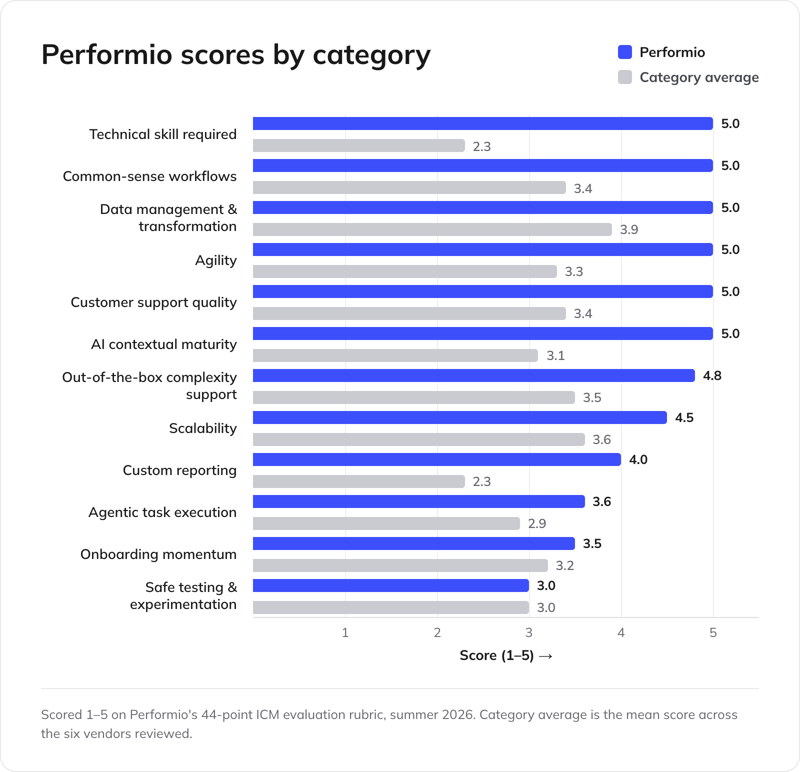
Performio at a glance
|
Pros |
Cons |
|
|
Performio makes commission tracking easy for admins to manage, and easy for sales reps to use. You don’t need to know programming languages, workflow logic, or spreadsheet formulas to build or report on your commission plans. And its unique component-based logic lets you adjust even the most complex plans without vendor support.
Performio’s AI helps organizations hit the ground running, cutting implementation time by 87 percent. As the most contextually-aware AI in the space, it also understands:
- How the software tracks commissions
- How your business works
- How your ERP and CRM data works
- How each of these areas interact in Performio
When sales reps want to understand their payouts or admins need to address disputes, Performio’s AI supports both parties with recommendations, and can even take action to streamline the dispute process. Everyone gets faster resolutions with accurate, meaningful responses.
Performio has the best custom reporting capabilities on the market, with in-tool support for advanced, flexible report building that requires little technical expertise. Admins can easily report on commissions as often as they need without any help from IT or professional services, and sales reps can drill into their own earnings and calculations with intuitive dashboards.
Its strong workflow design, intuitive data management, and broad out-of-the-box complexity support lighten the load on administrators. Handling SPIFs, adjusting hierarchies, and managing rates are natively supported and easy to update. Admins can use future-effective dates to plan ahead or make mid-cycle adjustments as needed.
Multiple sandboxes and version control in both runtime and testing environments let admins plan ahead without disrupting day-to-day operations.
When it comes to customer service, Performio is the only commission tracking software with guaranteed resolution times for premium support customers, a halo in the 2025 Forrester Wave for above-average customer feedback, and clearly defined time sensitivity requirements for SLA level 2 issues.
Bottom line: Performio delivers on both flexibility and ease of use—there’s no tradeoff between the two. With top-notch customer service, meaningful AI capabilities, and advanced built-in data management, it’s built to be the last commission tracking software you’ll ever need.
Schedule a demo to see what Performio can do for your organization.
2. Varicent
Overall score: 3.5 / 5
Most advanced AI plan modeling and analysis, but requires significant expertise.
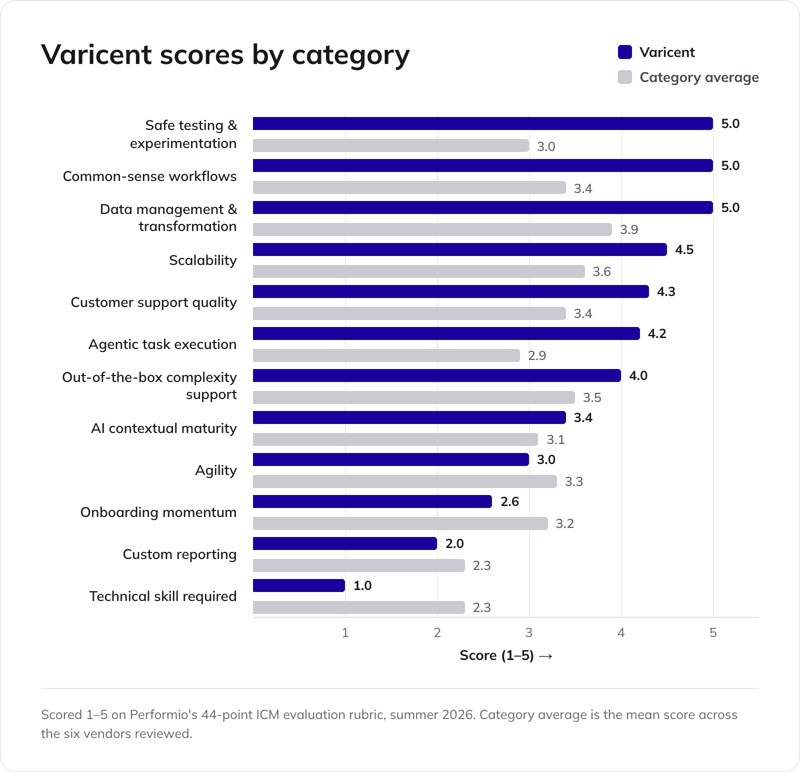
Varicent at a glance
|
Pros |
Cons |
|
|
Varicent is the only option with a full-platform testing sandbox, making it the strongest commission tracking software for testing and experimentation.
Varicent’s AI agents simplify plan optimization, scenario modeling, and data processing. Admins can use natural-language prompts to create data tables and importers.
Varicent is among the best in workflow automation, scalability, and high-volume data processing. It supports multi-level approvals, dispute resolution, and conditional workflows, while also enabling admins to reorganize territories, add data points, and manage Salesforce integrations directly in the tool.
Where Varicent falls short is ease of use. Using Varicent requires advanced proficiency in programming languages and workflow logic. Ideally, commission tracking software makes commission data accessible to your whole team. But in Varicent, you can’t build custom reports or manage your sales data without significant technical expertise (or expensive help from professional services).
And while Varicent does let you make mid-cycle adjustments like adding new crediting structures or incentive mechanisms, this requires changes to the system itself, not just your compensation plan. The same is true for building next year’s plan—it’s possible, but it takes some heavy lifting.
On average, Varicent is also the slowest to get you up and running. According to G2, implementation typically takes about 8 months, and time-to-value is more than a year and a half. Their customer service, however, is extremely fast. Varicent is one of the only two options with faster-than-average SLA response times at every severity level.
Bottom line: Varicent allows you to continually refine your commission plans—as long as you have the bandwidth for it. The tradeoff for its best-in-class testing capabilities is a heavy technical burden, slow implementation and time to value, and less agility than other solutions.
3. CaptivateIQ
Overall score: 3.2 / 5
Well-rounded and easy to use, but weak on customer service.
CaptivateIQ at a glance
|
Pros |
Cons |
|
|
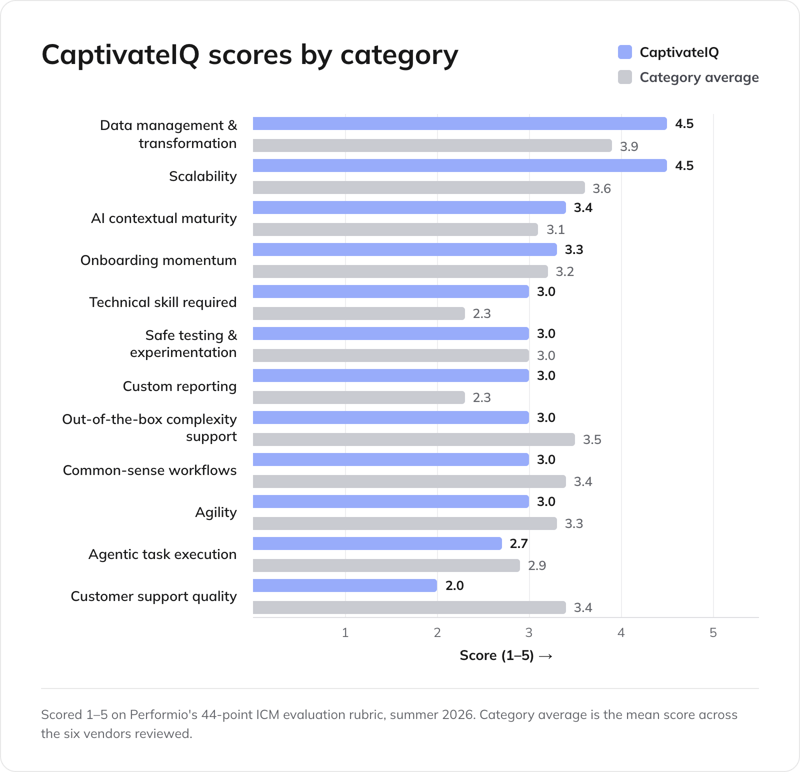
CaptivateIQ is one of the easiest commission tracking solutions to use. It only requires a basic grasp of programming languages and workflow logic rules, plus intermediate experience with spreadsheet formulas.
Since CaptivateIQ understands how sales data interacts with the software, admins can modify existing plans or even generate new ones with natural language prompts. The built-in AI can also model outcomes complete with actual calculations.
CaptivateIQ is one of the faster options to get started with. On average, implementation takes about one quarter, and most customers reach time-to-value in about 11 months. For an extra fee, they can also provide bespoke training and documentation, which most vendors don’t offer.
A blend of automation and manual processes makes CaptivateIQ more scalable than most other options. While admins have to manually add payees, once added, they can sync with your HRIS. There’s also in-tool support for reorganizing territories and adding new data points. Salesforce integrations are partly covered by six out-of-the-box connectors, but advanced integration work requires professional services.
CaptivateIQ struggles with testing, complexity, and workflows. It has a single testing environment with no version control, making it difficult to collaborate and keep track of changes. It doesn’t have out-of-the-box support for any common plan components—setting up components like SPIFs, custom hierarchies, and multiple crediting models requires technical expertise or vendor support. And CaptivateIQ doesn’t support workflows for single transaction disputes or conditional workflows based on approval status.
Bottom line: CaptivateIQ is best for SMBs that need something fast and simple. Those with complex plans or larger operations will find it more problematic due to its limited testing capabilities, slow customer support, and lack of out-of-the-box support for plan components.
4. Xactly
Overall score: 2.7 / 5
Great for testing changes and building plans, but very technically demanding.
Xactly at a glance
|
Pros |
Cons |
|
|
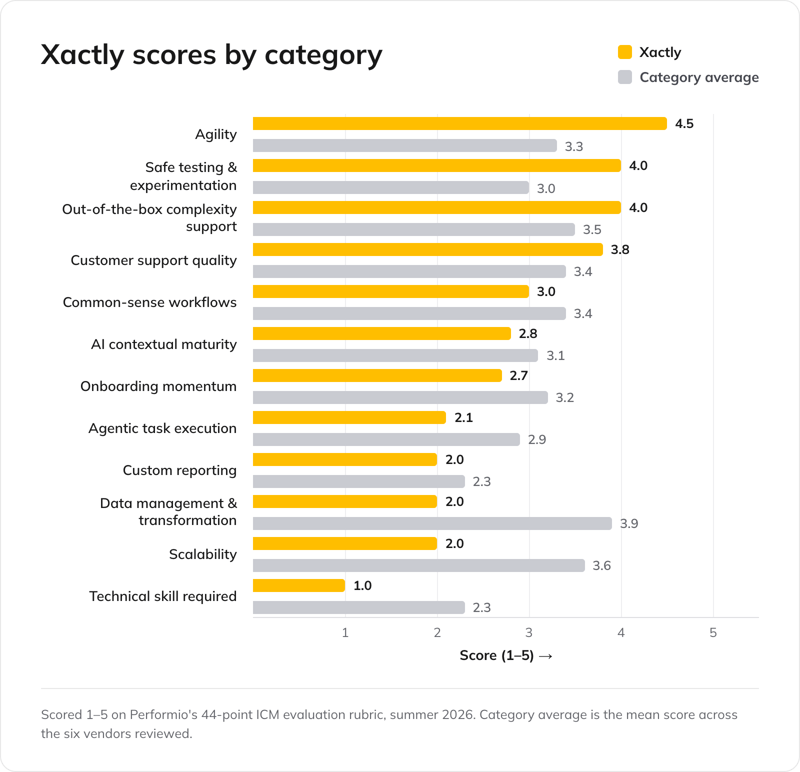
Xactly’s commission tracking software can support complex compensation plans—as long as you can handle the technical overhead. Getting the most from Xactly requires expert-level skills in programming languages and workflow logic, as well as intermediate knowledge of spreadsheet formulas.
Despite this, Xactly is one of the few options that doesn’t require coding, logic, or formulas to set up complex plan components like SPIFs, custom hierarchies, and multiple crediting models. However, none of these mechanisms are easy to adjust once they’re set.When reps dispute payouts, Xactly’s AI understands the software and your sales data well enough to take action, implementing resolutions into payouts, collecting approvals, and accelerating the entire process.
Xactly is also highly agile. It’s one of the only options that lets you build future plans or adjust current ones without requiring tweaks to the platform itself.
It falls short, however, in data management and scalability. Xactly is the only commission tracking software we reviewed that:
- Requires data to be preconfigured before import
- Has a fully manual process for payee management
- Completely depends on vendor support to manage Salesforce Data Connector (all other top solutions have self-service options)
And while Xactly does support user-defined batch processing, it lacks ETL capabilities and requires technical expertise to manage and transform data.
Xactly’s onboarding is slower than most, too. According to G2, average implementation takes almost two quarters, and time-to-value is about a year and a half.
Their customer support has strong SLA response times at the highest and lowest severity levels, and average response times in between. However, they don’t define time-sensitivity requirements or guarantee resolution times for premium support.
Bottom line: Xactly is about as technically demanding as Varicent, but with more capability gaps. It provides solid support for complex plans and workflows, and it accommodates changes and adjustments well. But organizations that can’t absorb the technical workload may struggle to track and report on their commissions.
5. Everstage
Overall score: 2.3 / 5
Fast implementation, good customer service, but limited capabilities.
Everstage at a glance
|
Pros |
Cons |
|
|
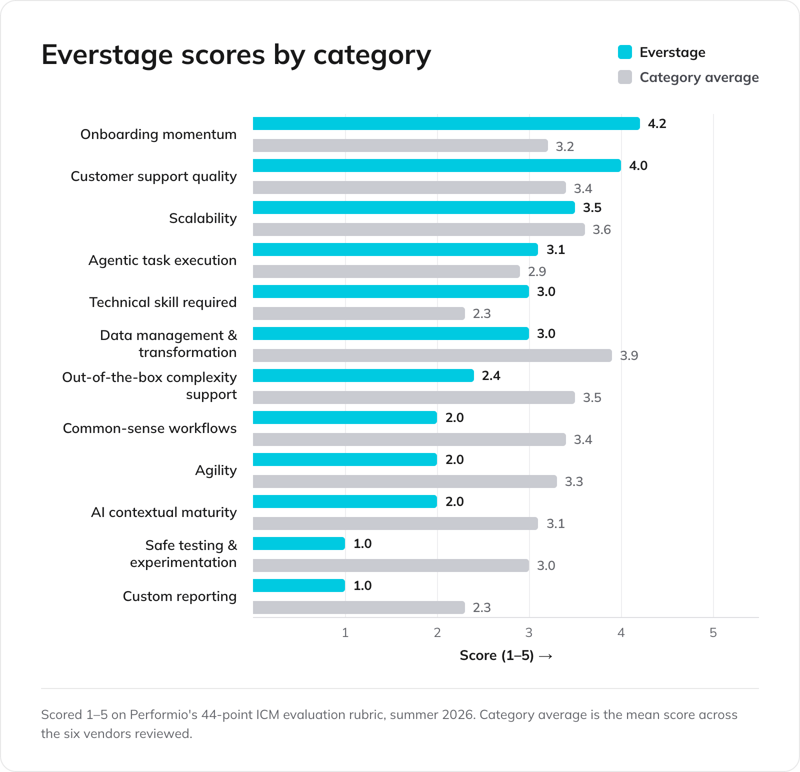
No one beats Everstage at onboarding. On average, customers are fully onboarded in just two months, the tool has paid for itself eight months in. They’re also the only vendor other than Performio to provide complimentary break-fix consulting.
That speed extends to their customer support, with faster-than-average SLA response times at every severity level. Their AI agents help accelerate dispute management, too.
It’s also relatively easy to use. After the onboarding process, adjustments and day-to-day tasks only require beginner-level programming proficiency and intermediate knowledge of both workflow logic and spreadsheet formulas.
But all that speed and ease comes at the cost of functionality. Everstage supports multi-level approval workflows, but won’t let you write workflows for single-transaction disputes or status-based approvals. There’s no testing environment or version control, which makes changing your commission plan both risky and complicated. And when you need to report on commissions, Everstage has minimal in-tool support—and even that takes intermediate technical skills to use.
Everstage is a mixed bag when it comes to data management, with built-in ETL capabilities and manual scripting to work around its lack of batch processing. But unlike the best solutions, transforming data depends on technical expertise.
Bottom line: Speed is the main thing Everstage has to offer. It’s easier to use than most, but it also does less than most. And while you’ll get your money’s worth sooner, enterprise and hypergrowth organizations may find themselves outgrowing Everstage soon too.
6. Salesforce Spiff
Score: 2.2 / 5
Strong data management, now part of the Salesforce ecosystem.
Salesforce Spiff at a glance
|
Pros |
Cons |
|
|
Salesforce acquired Spiff in 2024. In the coming years, we can expect Spiff to have some of the strongest integrations with the Salesforce ecosystem. And they’re already heading in the right direction—Spiff customers no longer need professional services to manage their connection to Salesforce.
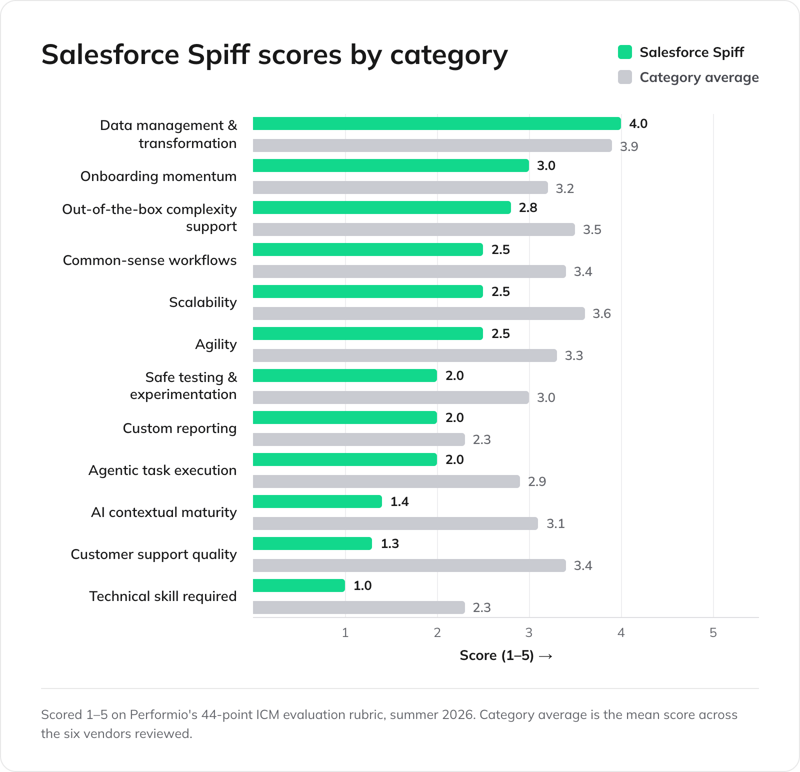
Salesforce Spiff scored above average in data management and transformation. Its built-in ETL and batch processing capabilities are limited, but most vendors have more gaps here, and managing your data doesn’t require any technical expertise.
While Spiff doesn’t have much in the way of custom reporting capabilities, its out-of-the-box dashboards and reports deliver a lot of the visibility sales reps and admins need.
Spiff’s AI doesn’t have context about a customer’s business needs or ICM data, but it can fetch and reference information about how the software works, which helps it model scenarios, forecast outcomes, and advise both parties in payout disputes.
Implementation is slower than most, but with its relatively low cost, most customers likely reach time-to-value in a year or less. Implementation isn’t the only area where Spiff is slow, though: their SLA response times are slower than average at every severity level.
Still, with Salesforce’s resources, new AI capabilities and ecosystem benefits could be just around the corner.
Bottom line: Spiff was below average in nearly every category, but as a new member of the Salesforce platform, things could change quickly. For now, its strength is data management. And for just about anything else, you’re probably better off with any of the other options on this list.
Choose the right commission tracking software
Commission tracking is an essential role of incentive compensation management. It’s key to ensuring you have the right incentives for your business goals, and keeping sales reps focused on the work that matters. This list compares the top commission tracking software vendors based on their actual capabilities, so you can zero in on the ones that actually fit your needs.
If you want more insight into the buying process, our complete Buyer’s Guide walks you through assembling the right team, building a decision framework, creating objective evaluation criteria, and scoring vendors consistently. Learn how to choose the right commission tracking solution with confidence, no matter where you are in the buying process.
Explore a better way to manage sales commission tracking with Performio.
Ready to evaluate your options?
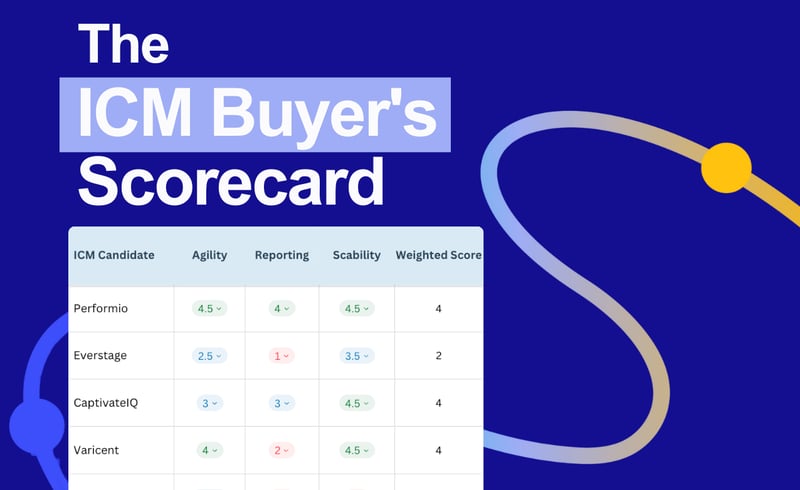
Use the ICM Buyer’s Scorecard to compare your key criteria and identify the commission tracking software that best fits your team’s needs. Try out the scorecard with your own buying criteria >>
Related Topics