We scored the leading sales compensation software options on a 44-point 1–5 scale rubric. Here are the overall scores:
- Performio (4.1)
- Varicent (3.5)
- CaptivateIQ (3.2)
- Xactly (2.7)
- Everstage (2.3)
- Salesforce Spiff (2.2)
Read on to learn the pros and cons of each.
Sales compensation plans quickly grow beyond spreadsheets. Providing the right incentives may require multiple crediting models, custom hierarchies, short-term SPIFFs, commission tiers, and other plan components. And trying to track, adjust, and report on increasingly complex compensation calculations in a spreadsheet isn’t just overwhelming—it’s error-prone, delicate, and unreliable.
Sales compensation software manages this complexity far better than spreadsheets. But some solutions are more capable or accessible than others. Depending on the vendor, you may need to rely on professional services or have a strong background in programming languages, workflow logic, or spreadsheet formulas to build and adjust your compensation plan. Or you may even find your plans limited by your solution’s capabilities.
The best platforms make it easy to do everything yourself—but they also greatly reduce the amount of manual work you have to do through automation and meaningful AI capabilities. With quality AI agents, sales compensation software can model scenarios, predict outcomes, resolve disputes, identify incentive conflicts, discover optimization opportunities, and more.
In 2026, we completed thorough reviews of today’s top sales compensation solutions to see which ones do that best.
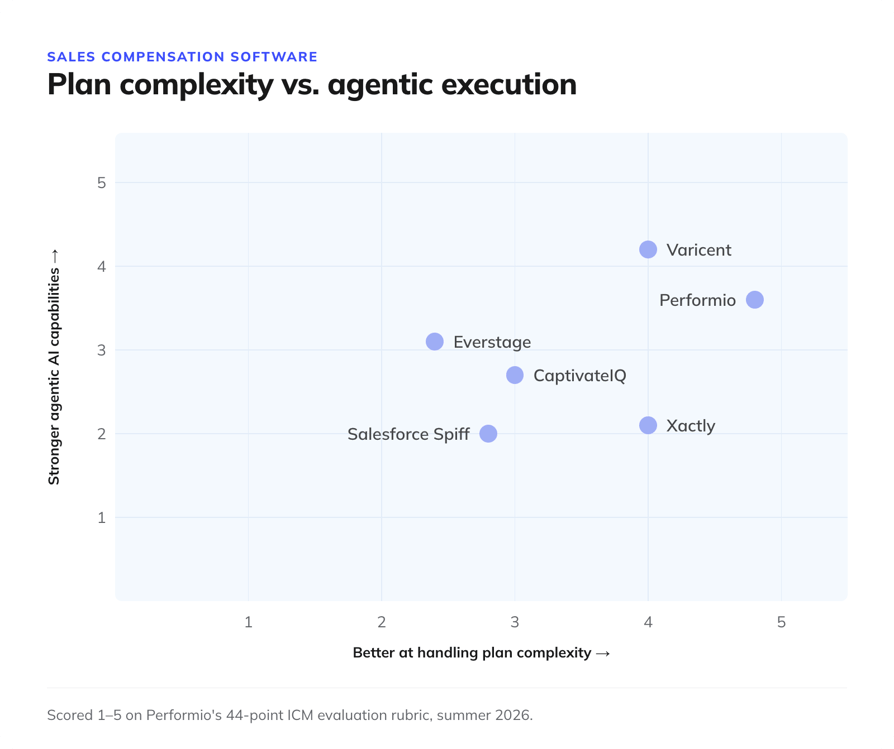
For the best balance of strong agentic AI capabilities and handling complexity, there are two clear leaders:
- Performio has the best out-of-the-box support for adding and adjusting compensation plan components without vendor support or technical expertise, along with sophisticated agentic AI capabilities.
- Varicent has the most advanced agentic AI, particularly when it comes to plan modeling and data processing, and its only downside with complexity support is that it requires more expertise to get the best mileage.
Now let’s get into how the top six sales compensation software solutions compare based on their actual capabilities.
How we ranked the top sales compensation software solutions
You’re right to be skeptical when a software vendor makes a “best of” list that includes their own product. But we rated ourselves and our competitors based on actual capabilities, using a rubric you can fact check yourself.
Through a combination of original research, well-known third-party evaluations like the 2025 Forrester Wave, and our own implementation consultants’ expertise, we built a list of 44 capability areas grouped into 12 core factors to consider when buying sales compensation software:
- Technical skill required
- Safe testing & experimentation capabilities
- Custom reporting capabilities
- Out-of-box complexity support
- Common-sense workflows
- Data management & transformation capabilities
- Scalability
- Agility
- Onboarding momentum
- Customer support quality
- AI contextual maturity
- Agentic task execution
Our rubric included a rating system for each factor with clear rationale and a 1—5 scale. We graded each vendor’s current capabilities (as of summer 2026) according to the scale, then consolidated the results and weighted each factor based on its importance to real ICM professionals. This gave us final scores for every vendor.
You can dig into the scoring system in our ICM Buyer’s Guide.
| The Best Sales Compensation Software | ||
|---|---|---|
| Vendor | Overall Score | Highlights |
| Performio | 4.1 | Easiest to use, best support for complexity |
| Varicent | 3.5 | Strongest in agentic AI use cases and testing features |
| CaptivateIQ | 3.2 | Beginner-friendly solution with quality custom reporting |
| Xactly | 2.7 | Strong AI capabilities, good complexity support |
| Everstage | 2.3 | Fastest implementation time |
| Salesforce Spiff | 2.2 | Best integration with the Salesforce ecosystem |
The 6 best sales compensation software solutions for enterprise teams
In this section, we’ll break down each platform’s scores and discuss their pros and cons in relation to the rest of the field.
- Performio (4.1)
- Varicent (3.5)
- CaptivateIQ (3.2)
- Xactly (2.7)
- Everstage (2.3)
- Spiff (2.2)
1. Performio
Overall score: 4.1 / 5
Unparalleled ease of use, unmatched complexity support
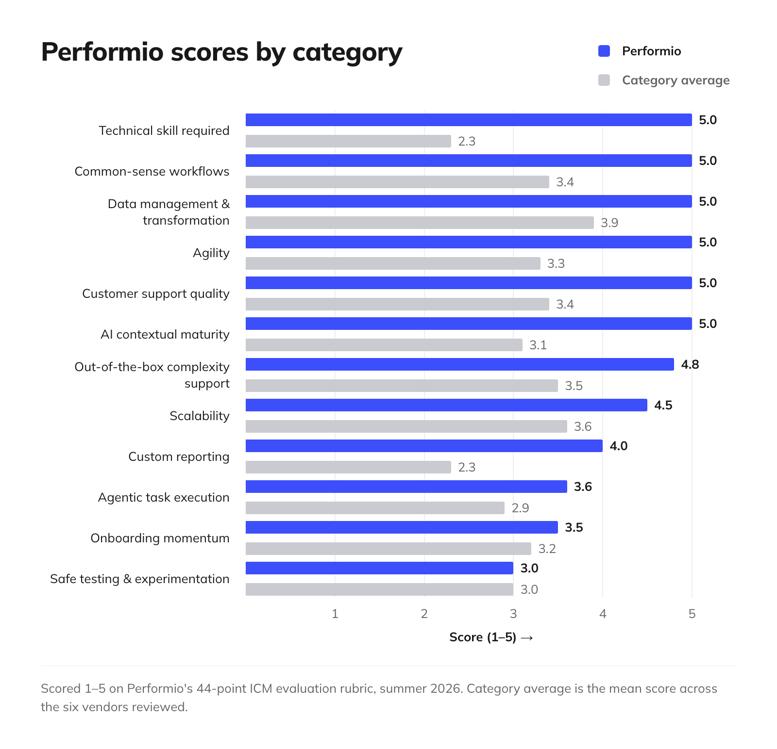
Performio at a glance
| Pros | Cons |
|---|---|
| No technical skills required | Testing sandbox has some gaps |
| Easy to modify most complex plan components out-of-the-box | Still building out day-to-day agentic AI capabilities |
| Intuitive workflows that support real-world approval processes | |
| Most contextually aware AI | |
| Strongest data management capabilities | |
| Easy to build new plans and adjust current ones | |
| Widely recognized for high-quality customer support |
Performio is the strongest all-around sales compensation solution for building, administering, and modifying comp plans. It’s the only software that requires zero experience with programming languages, workflow logic, or spreadsheet formulas—even for the most complex plans.
Getting started with Performio is incredibly quick thanks to its AI implementation agents, and once you’re set up with Performio, you’re set for good. Its unique component-based logic lets you adjust plan mechanisms without vendor support.
And while two other top contenders are widely recognized for their advanced agentic AI, Performio’s AI is the most contextually aware. It understands the precise relationships between:
- How plans work in the software
- Your business targets, needs, and vernacular
- Your ERP, CRM, and ICM data
Each of these areas can create interpretive gaps where AI has to make assumptions—leading to potential miscalculations, flawed analysis, and poor recommendations. Performio has the only built-in AI that leaves no room for these errors. It has direct access to everything it needs from the software and knows how all the pieces actually interact.
Performio also requires the least expertise for building custom reports. Admins can generate reports right in the tool without calling on IT or paying for professional services. And every sales rep can examine their earnings and calculations with intuitive dashboards.
Administrators can natively create and adjust SPIFs, custom hierarchies, and use multiple crediting models. With multiple testing sandboxes and version control, admins can safely push changes live mid-cycle or plan ahead with future-effective dates.
Performio also leads in customer service, where it was the only vendor to earn a halo in the 2025 Forrester Wave for above-average customer feedback. It’s the only sales compensation software that offers guaranteed resolution times to premium support customers and clearly defined time sensitivity requirements for SLA level 2 issues.
Bottom line: Performio doesn’t just balance flexibility and ease of use—it’s the best of both worlds. You never have to worry about growing out of Performio’s sales compensation software, and with the most contextually-aware AI in the field, it’s only getting better.
Schedule a demo to see what Performio can do for your organization.
2. Varicent
Overall score: 3.5 / 5
Most advanced agentic AI, but technically demanding software
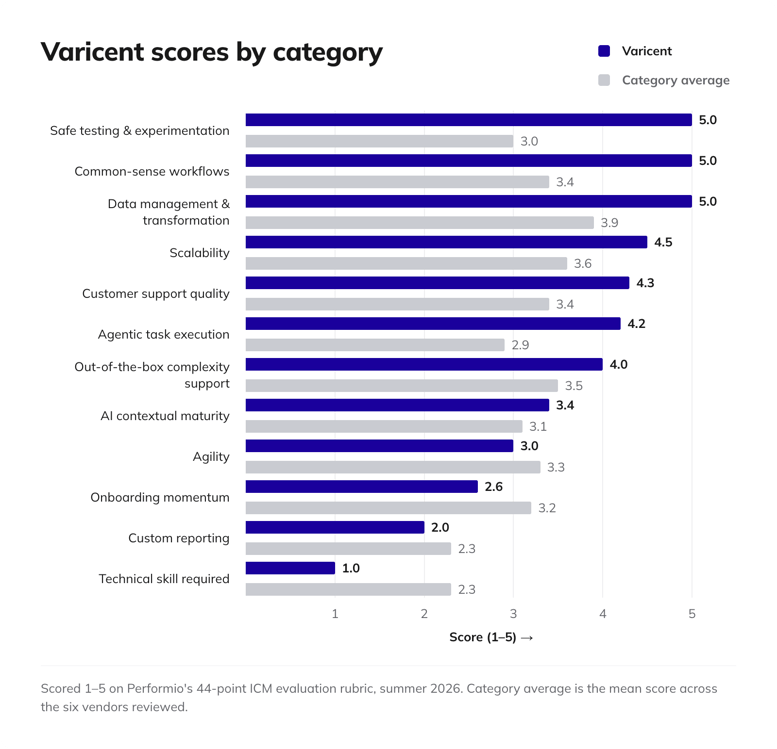
Varicent at a glance
| Pros | Cons |
|---|---|
| Most advanced AI plan modeling and analysis capabilities | AI lacks awareness of customer business context |
| Best sandbox for testing and experimentation | Building and adjusting plans require changes to the platform |
| Supports complex plan mechanisms out-of-the-box | Custom reporting and other basic tasks require expert-level technical skills |
| Highly scalable due to in-tool support for data points, territories, and Salesforce connector management | Lack of built-in ETL capabilities inhibit data management |
| One of the few options with batch processing | Slowest onboarding and longest time-to-value of top options |
| Fast response times across all SLA levels |
Varicent has the most advanced agentic AI capabilities and the best environment for testing and experimentation.
Its AI agents can proactively suggest ways to improve plans or recommend the best pathways toward a desired outcome through sophisticated regression analysis, scenario modeling, and forecasting capabilities. It also creates tables and importers from natural language prompts and recommends action items for both parties in disputes.
Varicent is also the only option with a full-platform testing sandbox, making it the best sales compensation software for testing and experimentation.
When it comes to automating workflows, Varicent is a very capable option, scaling with new data points, territory reorgs, and data management.
But Varicent is lacking when it comes to ease of use. Varicent supports even the most complex of compensation plans, but you can’t use it without expertise in programming languages and workflow logic. Building custom reports, managing sales data, or adjusting your plan all require significant technical skill or continual support from professional services.
It also takes the longest to implement. G2 suggests the average implementation usually takes about 8 months, and time-to-value typically stretches to about 20 months. But while onboarding is slow, their customer service is one of the fastest we reviewed.
Bottom line: Varicent trades flexibility for ease of use. The price for advanced AI and excellent support for complex plans is that everything takes more expertise, from building and adjusting plans to custom reporting and even data management.
3. CaptivateIQ
Overall score: 3.2 / 5
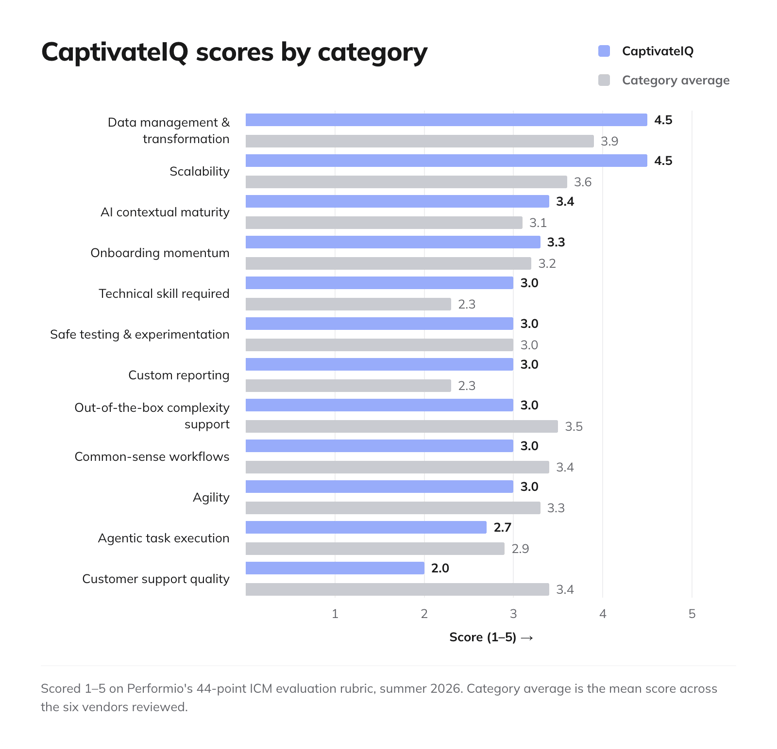
Beginner-friendly solution with strong data management, but poor customer service
CaptivateIQ at a glance
| Pros | Cons |
|---|---|
| Less technically demanding than most top vendors | Can be difficult to set and adjust plan mechanisms |
| AI can generate plans, model scenarios, and advise in disputes | Limited options for workflow automation |
| Custom reporting is relatively accessible | Changing compensation plans requires changing the software |
| Allows for adding new data points and reorganizing territories in-tool | Lacks onboarding support for enterprise customers |
| Fast implementation time and time-to-value | No version control for testing and experimentation |
| Offers training and documentation during onboarding (for a fee) | Slow or average customer support at every SLA tier |
CaptivateIQ is a beginner-friendly option with fast onboarding, decent AI capabilities, and adequate custom reporting. But organizations with complex compensation plans may have trouble with it.
It only requires entry-level experience with programming languages and workflow logic rules, and intermediate skills with spreadsheet formulas, but it doesn’t have out-of-the-box support for common plan components, which means you may be more reliant on those technical skills than you would with other options.
CaptivateIQ’s built-in AI lets admins use natural language prompts to modify existing plans, generate new ones, and model outcomes.
It usually only takes about three months to implement CaptivateIQ, and 11 months to hit time-to-value. And unlike most vendors, they offer custom training and documentation during onboarding, though it does cost extra.
As your organization grows and evolves, CaptivateIQ lets you add payees and datapoints, as well as reorganize territories. Some Salesforce integrations can be connected out-of-the-box, but others have to be set up through professional services.
CaptivateIQ is poorly suited for testing and experimenting with plan changes. With a single testing environment and no version control, it’s difficult to safely prepare new plans or keep track of who changed what, and when.
Bottom line: CaptivateIQ is best for businesses that have limited technical resources, simple compensation plans, and low growth expectations. It’s fast to get started, but poor testing capabilities and slow customer support make it ill-suited for larger organizations with more mature sales operations.
4. Xactly
Overall score: 2.7 / 5
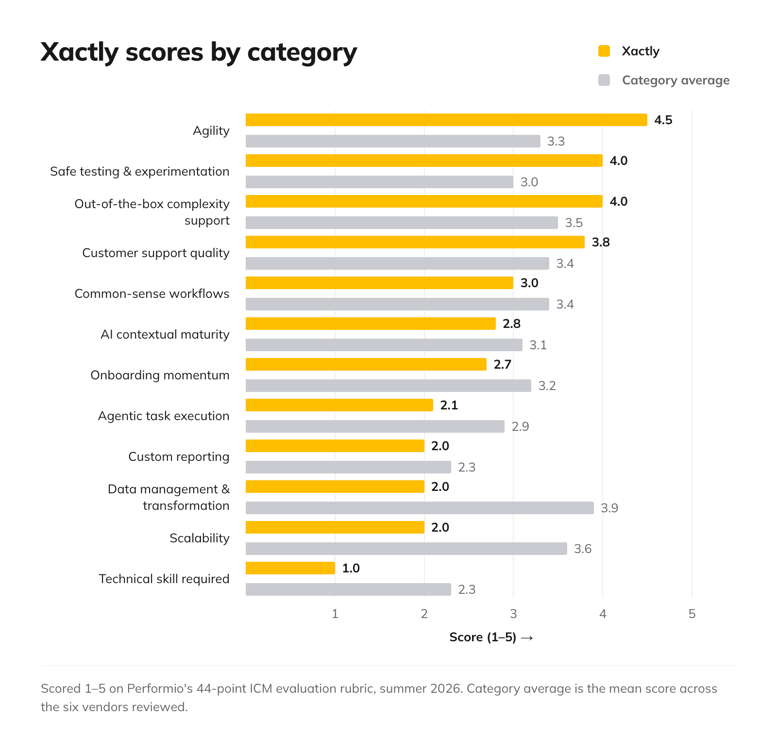
Ideal for building, adjusting, and testing compensation plans, but requires significant expertise
Xactly at a glance
| Pros | Cons |
|---|---|
| Building and adjusting plans doesn’t require changes to platform | One of the most technically difficult options for custom reporting |
| Supports complex plan mechanisms out-of-the-box | Plan components can’t be easily adjusted in-tool |
| Advanced AI dispute management capabilities | Requires data to be preconfigured before importing |
| Second-strongest choice for testing and experimentation | Worst scalability of top sales compensation software options |
| Allows automation of most common workflows | Slow onboarding and long time-to-value |
Xactly is a highly capable sales compensation software, but it’s limited by your technical expertise and reliance on professional services. Adjusting plan components, building custom reports, and managing your data requires intermediate knowledge of spreadsheet formulas, and expert-level experience with programming and workflow logic rules.
Despite the heavy technical lift, Xactly is one of the best options on the market when it comes to building and adjusting sales compensation plans. While most competitors let you build and modify your plan with a future effective date, Xactly is one of the only two options that doesn’t require changes to the platform itself first.
It’s also one of the few options that lets you set up complex plan components without coding, logic, or formulas. And while its AI in general is below average, its dispute management capabilities are pretty advanced. It has enough context to not just advise reps and admins through disputes, but to actually take actions like collecting approvals and implementing resolutions into payouts.
Data management and scalability are where Xactly tends to hold organizations back due to three unique shortcomings. It’s the only vendor we reviewed that:
- Requires data to be preconfigured before import
- Uses a fully manual process to add new payees
- Doesn’t have any self-service options to manage Salesforce Data Connector
Onboarding is slow, too. The implementation process typically takes almost half a year, and most won’t reach time-to-value for 18 months.
Their customer support depends on SLA support level, with fast response times at the highest and lowest severity levels, and average response times at SLA levels 2 and 3.
Bottom line: Xactly is a strong choice for businesses that want to continually iterate on their compensation plans and prepare for future changes. But its value to your business completely depends on your ability to handle its technical demand, even for basic processes like building reports, managing sales data, and adjusting components.
5. Everstage
Overall score: 2.3 / 5
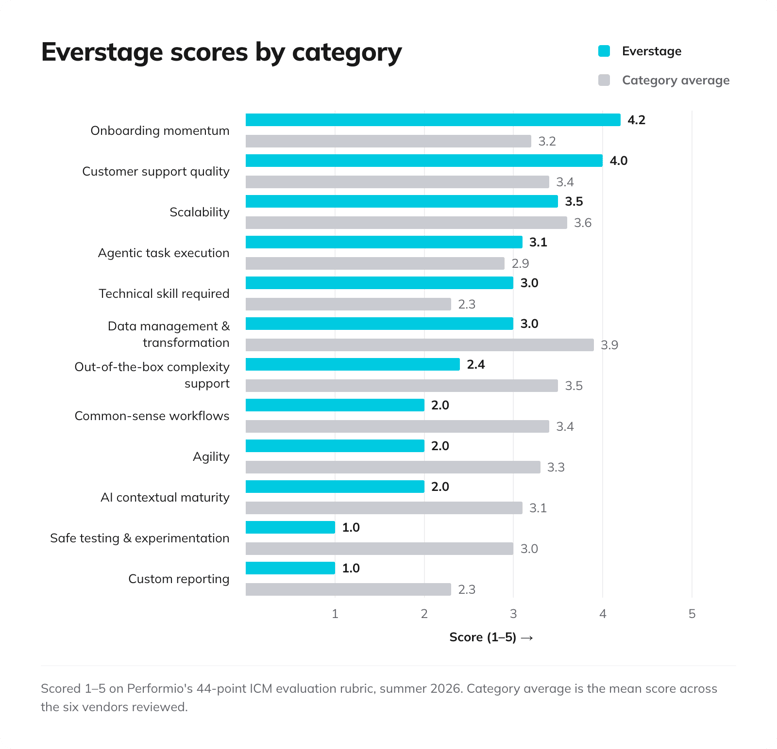
Excellent onboarding and customer service, but lacks many basic capabilities
Everstage at a glance
| Pros | Cons |
|---|---|
| Fastest implementation and time-to-value | Weak out-of-box support for enterprise complexity |
| Complimentary break-fix consulting | No testing environment and no version control |
| Built-in ETL capabilities for data management | Very limited reporting capabilities |
| Self-service Salesforce connector management | Doesn’t support reorganizing territories to accommodate growth |
| Fast customer support response times at all SLA tiers | Difficult to execute both future and mid-cycle plan changes |
Everstage is best-in-class when it comes to onboarding. Implementation typically takes about two months, and average time-to-value is only eight months. They’re also the only vendor other than Performio to provide complimentary break-fix consulting.
Their customer support is faster than most, too. At every severity level, they’re the only vendor that matches Varicent’s SLA response times.
It also takes less technical skill than most options. It only requires beginner-level programming proficiency and intermediate knowledge of both workflow logic and spreadsheet formulas. But as with CaptivateIQ, you may need to use that expertise more often, because Everstage’s built-in capabilities are more limited.
Unfortunately, Everstage lacks essential compensation management capabilities. The only workflows you can automate are multi-level approval. And without a testing environment or version control for tracking changes, building new plans and preparing mid-cycle changes is possible, but risky. Custom reporting is both extremely limited and difficult to use.
Everstage has helpful data management capabilities like built-in ETL, and you can code a process for batch processing. But in general, it takes technical skill to manage and transform your data.
Bottom line: People choose Everstage for its speed and low technical requirements. But it has a lot less to offer than other options, which means choosing Everstage now may mean upgrading to a better solution down the road.
6. Salesforce Spiff
Score: 2.2 / 5
Sales compensation software backed by the world’s leading CRM platform
Salesforce Spiff at a glance
| Pros | Cons |
|---|---|
| Salesforce ownership could mean big improvements | Below average in nearly every category |
| Quality dashboards improve visibility into payouts | Requires expert experience in SQL |
| AI makes recommendations for payout disputes | No in-tool support for building custom reports |
| Data management and transformation doesn’t require technical skills | Known to charge unexpected overages, even on smaller accounts |
| Built-in ETL capabilities | Slow implementation |
| Only requires beginner-level skills in workflow logic |
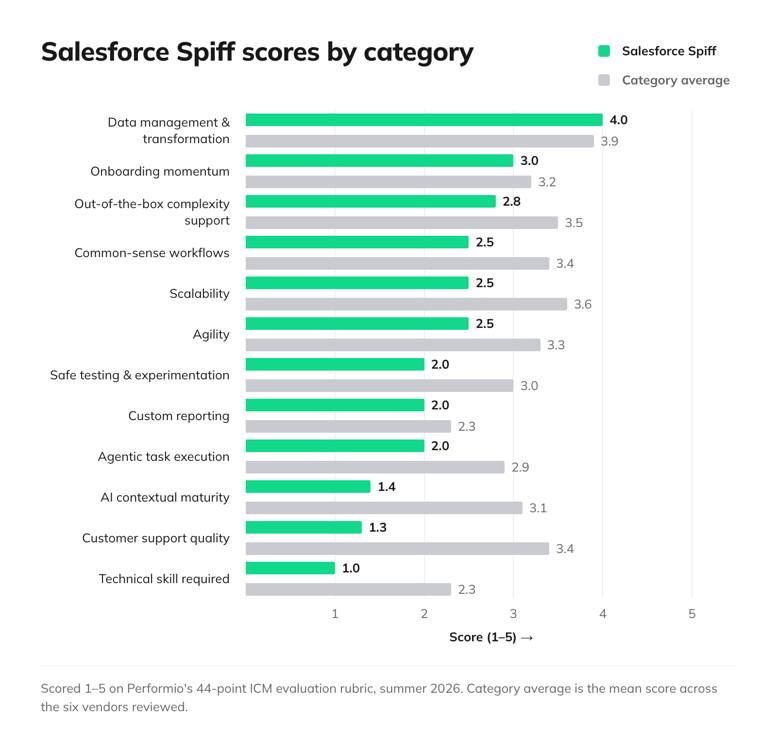
Spiff is now owned by Salesforce, the most popular CRM platform in the world. Since the acquisition in 2024, Spiff has strengthened its connection to the Salesforce ecosystem and no longer requires professional services to manage the connection.
Salesforce Spiff’s main strength is data management and transformation. In fact, it’s the only category Spiff scored above average in. Most vendors completely lack either built-in ETL or batch processing capabilities, but Spiff can perform both functions in a limited capacity, and you don’t need technical expertise to manage your data.
After the Salesforce acquisition, Spiff deprecated their business intelligence capabilities, leaving the tool without custom reporting features. However, Spiff’s high quality out-of-the-box dashboards and reports help compensate for this gap.
Spiff’s AI is pretty basic. But it can model scenarios, forecast outcomes, and advise both parties in payout disputes.
Getting started with Spiff is pretty slow, but it doesn’t take long to reach time-to-value once implementation is complete. The whole process usually takes a year or less.
Bottom line: The main selling point of Spiff is that it’s backed by one of the biggest names in sales software. It remains to be seen how much the tool will improve as part of the Salesforce platform, but as is, Spiff is the weakest all-around option we evaluated.
Choose the right sales compensation software
Sales compensation software is an investment you only want to make once. Choosing the right tool ensures you can build and fine-tune the compensation plans that best fit your business needs, rather than balancing your needs against your software’s limitations. This list compares the top sales compensation software vendors based on their actual capabilities, so you can make the right choice the first time.
If you want more insight into the buying process, our complete ICM Buyer’s Guide walks you through assembling the right team, building a decision framework, creating objective evaluation criteria, and scoring vendors consistently. Learn how to choose the right sales commission software with confidence, no matter where you are in the buying process.
And to see what Performio can do for your organization, request a demo today.
Ready to evaluate your options?
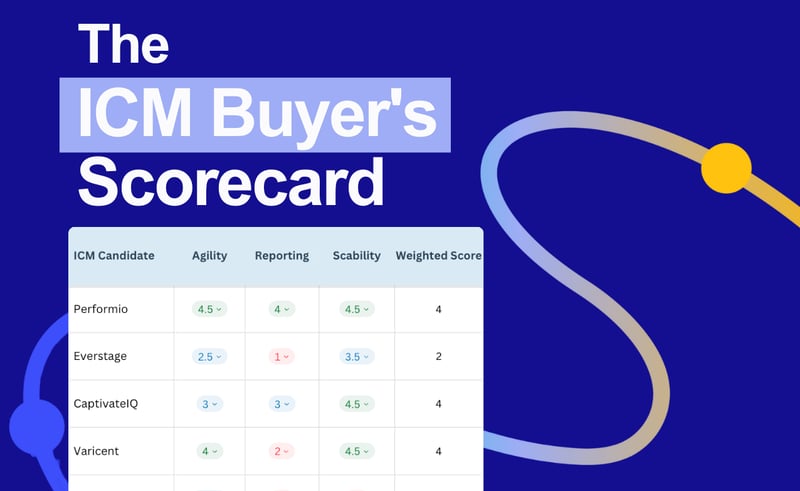
Use the ICM Buyer’s Scorecard to compare your key criteria and identify the commission tracking software that best fits your team’s needs. Try out the scorecard with your own buying criteria >>
Related Topics